
Instagram does not need to ban an account for bought followers to become expensive.
Fake followers change the numbers that creators, ranking systems and brands use to judge an account. They increase the follower count without adding the same amount of real attention, sharing or buying intent.
I reviewed 38 academic papers published between 2010 and 2025, along with Meta’s ranking documentation and current influencer-audit benchmarks. The research has changed a lot in 15 years. Early detectors looked at obvious clues such as posting frequency and usernames. Newer systems combine account behaviour, network structure and machine learning.
The result is uncomfortable for anyone buying followers: the number on the profile is easy to inflate. The signals underneath it are much harder to fake.
98.24% detection accuracy.
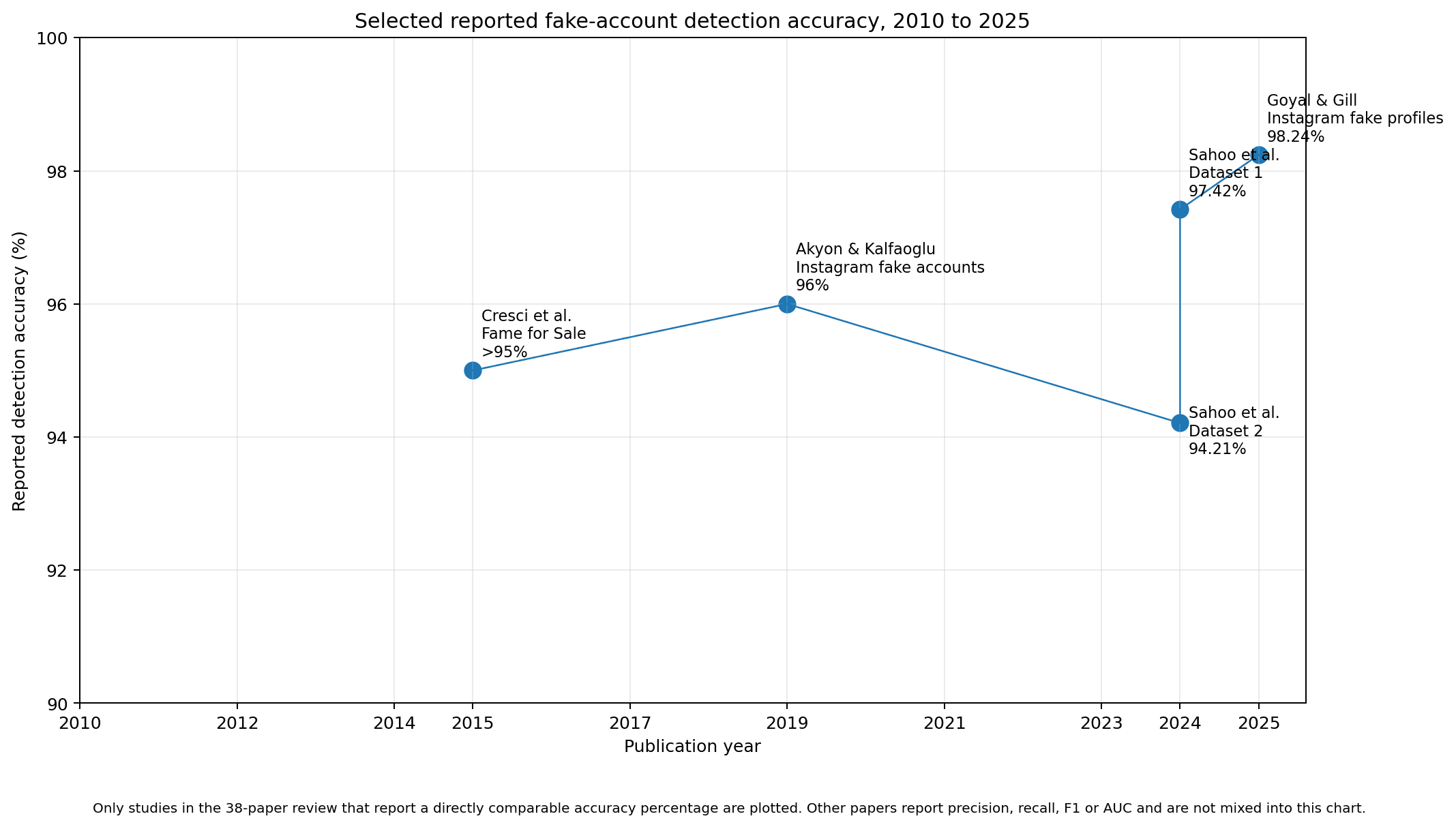
A 2025 Scientific Reports study achieved 98.24% accuracy when classifying fake Instagram profiles using an optimized machine-learning model.
More than 99% precision.
SynchroTrap, an earlier large-scale detection system, identified coordinated malicious-account campaigns with greater than 99% precision.
10% to 20% fake followers can be normal for smaller creators.
Modash says accounts below 50,000 followers commonly contain roughly 10% to 20% fake followers even when the creator did not buy them. It recommends avoiding creators whose audiences are more than 50% fake.
The question everyone asks first: will I get banned?
Buying followers can violate Instagram’s rules, but a ban is not the only risk worth thinking about.
The more predictable problem is measurement.
A creator can buy 20,000 followers today and still have an account tomorrow. That does not mean the purchase worked. The follower number went up, but the audience underneath it did not become 20,000 people more interested in the content.
That difference appears anywhere performance is measured against audience size.
If a creator has 100,000 followers but only 40,000 behave like a real audience, the profile may look larger while performing like a much smaller account.
The follower count is visible.
The missing attention is visible too, once someone measures it.
TRAP: the four ways fake followers hurt an account
The TRAP framework separates the damage into four parts: time and attention, reach, audits and the follower-to-engagement ratio.
| Part | What changes | Why it matters |
|---|---|---|
| T: Time and attention | Bought followers contribute little genuine viewing or profile activity | The audience becomes larger without the same increase in meaningful behaviour |
| R: Reach | Fake followers rarely create meaningful shares or sends | Sharing behaviour is an important distribution signal |
| A: Audit | Audience-quality tools can identify suspicious follower patterns | Brands can screen an account before paying for a campaign |
| P: Poisoned ratio | Followers rise faster than genuine engagement | Headline engagement rates become weaker |
These problems overlap, but they are not the same.
A creator may have weak engagement without having fake followers. A creator may also have some fake followers without having bought them. The useful question is whether the audience size and audience behaviour still make sense together.
T: Time and attention do not rise with the follower count
Bought followers increase the size of the audience on paper, but they do not automatically increase the amount of genuine attention a creator receives.
Instagram’s ranking systems use predicted user actions rather than treating every follower as equally interested in every post. That is why a large follower count does not guarantee distribution.
A real follower can watch, save, share, visit a profile, reply and come back later.
A purchased account may do none of those things.
That gap matters because ranking systems are trying to predict whether a specific person will find a specific piece of content interesting. A follower who repeatedly shows no meaningful behaviour provides very different information from a follower who regularly watches and shares the creator’s posts.
Buying an audience therefore solves the easiest metric to change: the public follower count.
It does not create the attention that made the follower count useful in the first place.
R: Reach depends on behaviour fake followers struggle to reproduce
Fake followers can inflate visible activity, but meaningful sharing is harder to manufacture at scale.
Instagram head Adam Mosseri has repeatedly discussed watch time, likes and sends as important ranking signals. Sends matter because they represent a person deciding that a post is worth sharing directly with someone else.
A bot can be programmed to like a post.
A purchased follower can be instructed to leave a generic comment.
Neither action automatically creates a genuine conversation between two people.
That distinction matters most when a creator wants to reach people who do not already follow them. Recommendation systems need evidence that content is worth showing beyond the existing audience.
A follower number does not provide that evidence by itself.
Behaviour does.
A: Brands can audit the audience before signing a deal
Brands no longer have to judge an influencer by follower count alone.
Audience-quality platforms such as HypeAuditor and Modash analyse follower patterns, suspicious accounts, engagement quality and audience composition before a campaign begins.
HypeAuditor’s 2024 influencer-marketing report specifically includes analysis of fraud among Instagram influencers.
Modash gives a useful practical benchmark:
Creators below 50,000 followers typically have around 10% to 20% fake followers.
It describes less than 25% as a useful target.
It recommends avoiding audiences with more than 50% fake followers.
That distinction is important because some fake followers accumulate naturally. Bots follow legitimate creators too.
An audit should therefore answer a better question than “does this account have any fake followers?”
The useful question is whether the level and pattern are plausible for an authentic audience.
P: The follower-to-engagement ratio gets worse by arithmetic
If the follower count rises while genuine engagement stays the same, a follower-based engagement rate falls automatically.
Imagine an account with 40,000 real followers.
If a post gets 2,000 genuine engagements, the follower-based engagement rate is:
2,000 ÷ 40,000 = 5%
Now add 60,000 bought followers and assume they contribute no genuine engagement.
The same 2,000 engagements are now measured against 100,000 followers:
2,000 ÷ 100,000 = 2%
Nothing about the real audience became worse.
The denominator changed.
Measured against the inflated follower count, the engagement rate is now 60% lower than it was before the purchase.
That is why follower inflation can make a real audience look weaker rather than stronger.
What the detection research actually shows
Fifteen years of research shows a clear pattern: fake accounts became more sophisticated, so detection methods became more sophisticated too.
The early research often relied on hand-picked account features.
Chu and colleagues showed in 2010 that automated accounts could be separated from humans by patterns in posting behaviour and timing.
Cresci and colleagues later tested the fake-follower market directly. Their 2015 paper, Fame for Sale, used more than 95,000 labelled accounts and showed that purchased followers could be detected using publicly available account information.
Then the field moved beyond individual profiles.
Researchers began analysing connections between accounts, coordinated activity and groups that behaved too similarly to be independent humans.
SynchroTrap is one of the strongest examples. The system identified 1,156 malicious campaigns involving more than 2 million accounts, with precision above 99%.
Later work used increasingly complex machine-learning approaches.
The 2025 Scientific Reports study by Goyal and colleagues combined Random Forest, XGBoost and class-balancing methods on an Instagram fake-profile dataset.
Its reported results were:
98.24% accuracy
98.3% precision
98% recall
98.34% F1 score
The paper also states an important limitation: the dataset was relatively small, so those results should not be treated as proof that every fake account on Instagram can be detected with 98% accuracy in production.
That is the broader lesson from the literature.
There is no single permanent “fake follower detector.”
There is an arms race between fake-account operators and detection systems.
What recovery actually costs
Recovery starts by accepting that the inflated follower number may need to fall.
There is no credible universal rule saying every affected account needs exactly six months, twelve months or a specific percentage purge. Recovery depends on how many suspicious followers exist, how the account acquired them and whether the remaining audience still engages.
The practical process is simpler:
First, audit the audience and identify the scale of the problem.
Second, stop adding artificial followers or engagement.
Third, remove suspicious accounts where doing so is safe and practical.
Fourth, rebuild performance using content that earns real watch time, saves, shares and replies.
Fifth, judge recovery using audience behaviour rather than trying to restore the old vanity number.
The visible follower count may fall.
That is not necessarily a setback.
If 70,000 real people are more interested in the content than an audience of 150,000 mixed real and fake accounts, the smaller number can be the healthier business asset.
The one number that ends the debate
The most useful number in this research is not the size of the fake-follower market.
It is 98.24%.
That is the accuracy reported by one 2025 Instagram fake-profile detection study. It does not mean every brand tool or Instagram system detects 98.24% of fake followers. The study used a specific dataset and methodology, and the authors themselves note limits to how broadly the result can be generalized.
What it does show is how far the detection field has moved.
Buying followers used to be discussed as a question of whether someone would notice.
Today, public profile features, behavioural patterns and network structure can all be analysed computationally.
The follower number is still easy to buy.
Credible audience behaviour is much harder.
Sources
Ferrara, E. et al. The Rise of Social Bots. Communications of the ACM, 2016.
Cresci, S. A Decade of Social Bot Detection. Communications of the ACM, 2020.
Cresci, S. et al. Fame for Sale: Efficient Detection of Fake Twitter Followers. Decision Support Systems, 2015.
Cao, Q. et al. Uncovering Large Groups of Active Malicious Accounts in Online Social Networks. ACM CCS, 2014.
Goyal, B. et al. Instagram fake profile detection using an ensemble learning method. Scientific Reports, 2025.
HypeAuditor. State of Influencer Marketing 2024.
Modash. Fake followers 101: Understanding audience quality.
About the author
Talha Abrar runs Dopameme, an organic social agency that has audited follower quality for clients across 4 continents.
