
Most people meet a successful creator at the end of the story.
The lighting is good.
The sentences sound effortless.
They look comfortable on camera.
Then somebody watching their third attempt thinks:
“I am just not a natural at this.”
Cat Goetze is a useful case because there is an unusually long public record showing what came before the version people know as CatGPT.
Before the hundreds of thousands of followers, there were years of videos.
Before short-form AI content, there was Cath in College.
Before a product launch generated $120,000 in three days, essentially the same product had been posted in 2023 and gone almost nowhere.
The product did not suddenly teach her how to communicate.
She had spent years doing that part already.
The accidental experiment
In 2023, Goetze built a Bluetooth-enabled landline phone because she wanted a way to take calls without spending as much time on her smartphone.
She modified a physical landline handset, made a Shopify store and posted the idea online.
Almost nothing happened.
Goetze later told Shopify that she had “no reach” and that the store flopped.
Two years later, she brought essentially the same product back.
This time she had built CatGPT, an audience that already knew her voice, taste and approach to technology.
The outcome was completely different.
The 2025 post reached roughly 8 million views in the case record.
Physical Phones passed $120,000 in sales in its first three days, according to documents reviewed by CNBC Make It.
By the end of 2025, the business had generated more than $789,000 in sales.
Same basic phone.
Different launch conditions.
That difference is why the story is useful for anyone asking how long it takes to become comfortable on camera.
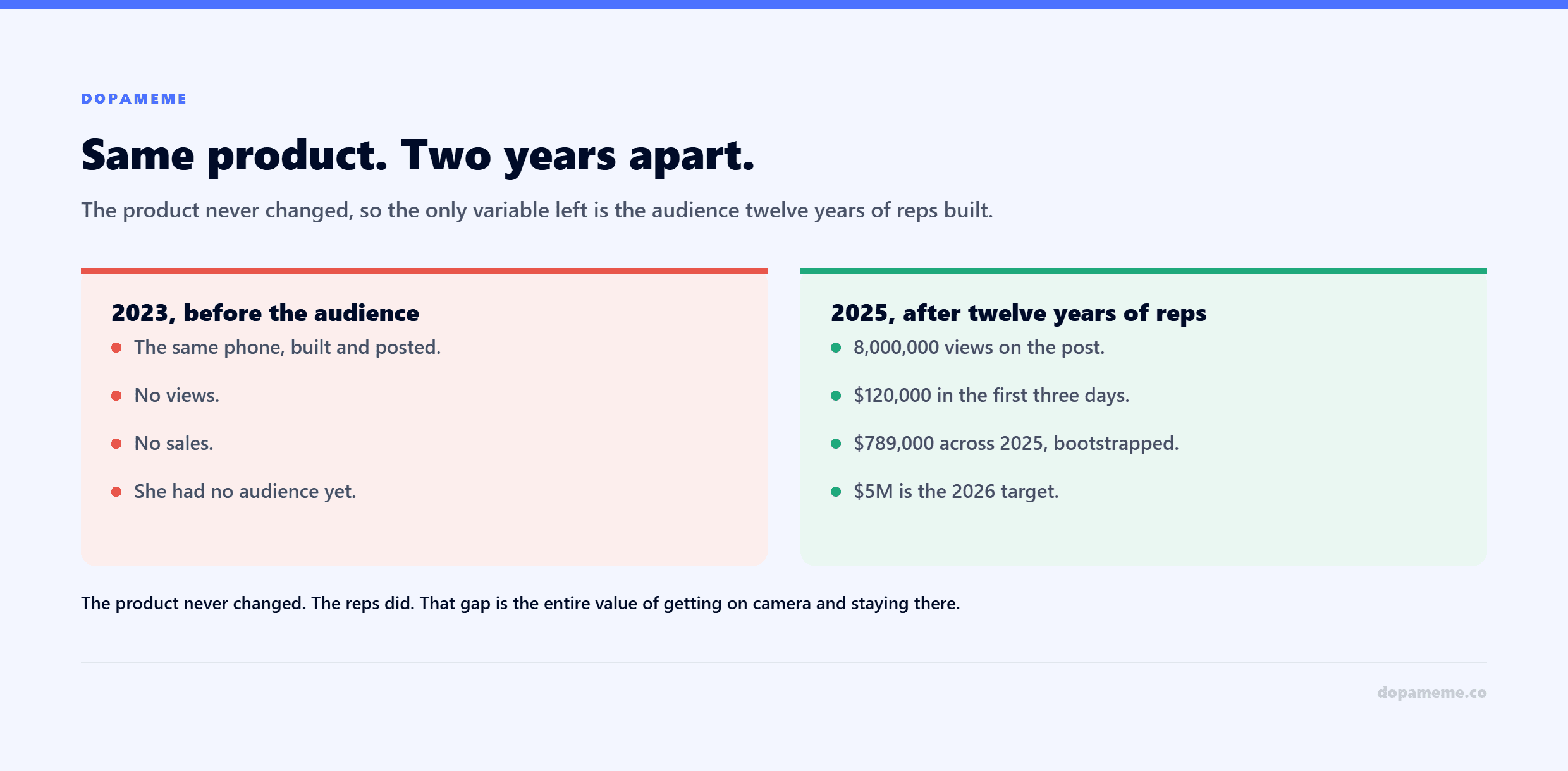 .
2023, before the audience
- Same core phone
- Almost no reach
- Store flopped
2025, after years of reps
- ~8M views
- $120,000 in the first three days
- $789,000 across 2025
Recommended caption:
The product was essentially the same. The creator, audience and distribution conditions were not.
Recommended featured image: Use this graphic as the article’s main/OG image.
Stage 1: years of footage before CatGPT existed
The useful part of Goetze’s story starts long before Physical Phones.
She had been making videos since her teens.
By 2016, Stanford Magazine reported that her Cath in College vlog had more than 6,500 subscribers.
By June 2017, The Stanford Daily reported roughly 17,500 subscribers and described a creator who had already begun becoming more deliberate about audio, storytelling and structure.
By the end of the original run, the archive contained roughly 157 videos.
Some were polished.
A lot were not.
That is the point.
The public record contains years of ordinary practice that most people never see when they discover somebody after the growth happens.
Goetze was not waiting until she had a perfect content strategy.
She was filming Stanford life.
Answering questions.
Vlogging.
Interviewing people.
Trying different formats.
Learning what sounded awkward.
Learning what felt natural.
Learning how to finish a thought while a camera was pointed at her.
Those repetitions are difficult to see in a follower count.
They are easy to see in an archive.
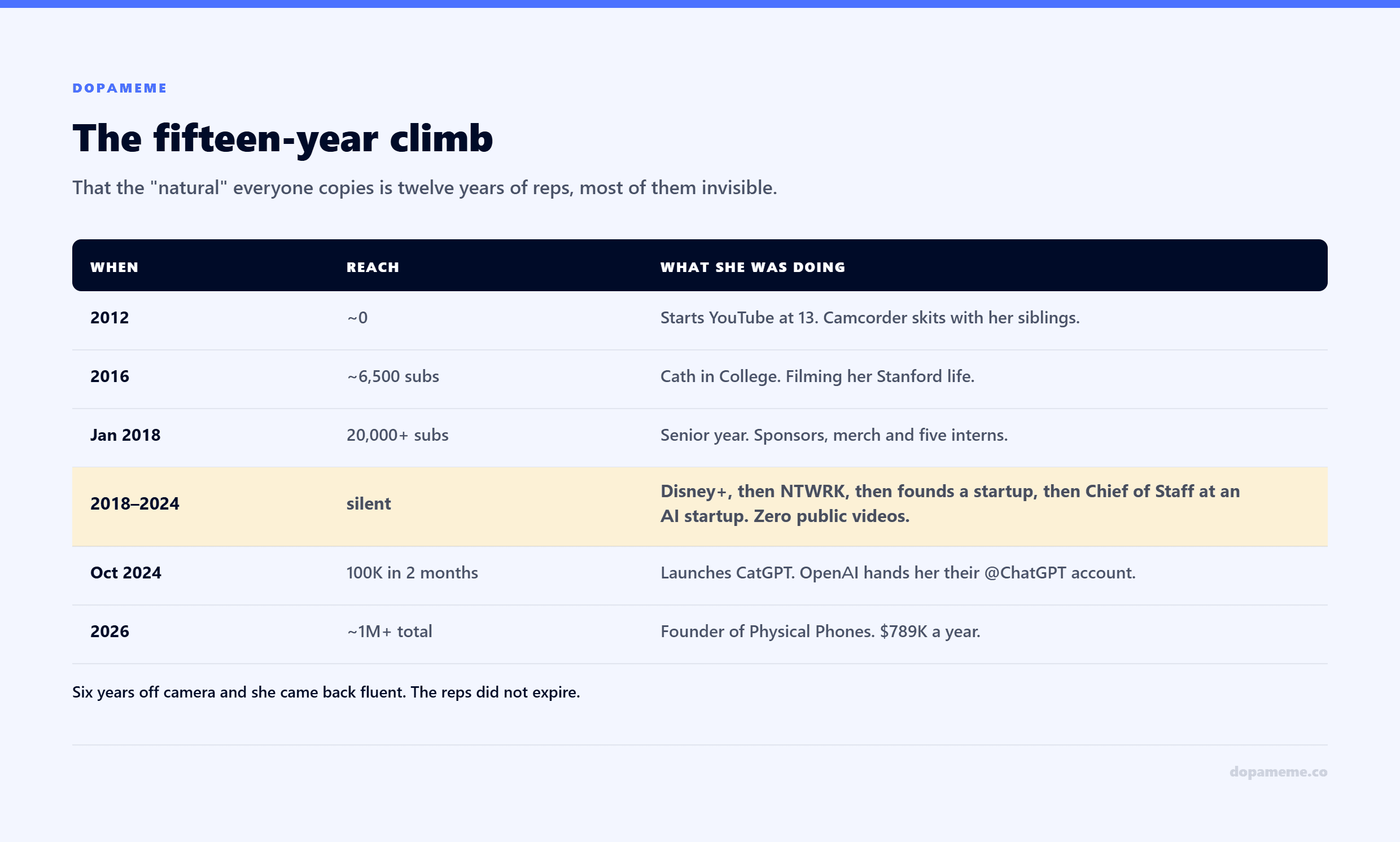
What looks “natural” at the end of the timeline has years of public practice underneath it.
Camera confidence did not appear when the follower count did
This is where people often reverse cause and effect.
A creator becomes successful.
They look comfortable.
So viewers assume the comfort came with success.
Goetze’s archive shows the opposite sequence.
The camera practice came first.
The audience came later.
Her early Cath in College work already required the basic abilities creators struggle with today:
Speaking without reading.
Holding attention.
Explaining an idea clearly.
Moving between prepared thoughts and spontaneous reactions.
Developing recognizable mannerisms and a voice.
Recovering when a sentence comes out wrong.
None of those skills require a million followers.
They require recordings.
Then she stopped for six years
In 2018, the original public-video run ended.
Goetze then spent roughly six years away from regular public content creation.
Her old channel effectively freezes the first phase of the experiment.
One era ends.
Nothing resembling the later CatGPT scale exists yet.

Credit:
Cath in College / Cat Goetze
Suggested caption:
The last phase of the original channel is visible in the archive. The long gap before CatGPT is part of the evidence.
The surprising part is what happened when she came back.
Stage 3: six years later, 100,000 followers in under two months
Goetze returned to public content in 2024 with CatGPT.
It did not take another six years to relearn how to speak to a camera.
In a post from that period, she said the previous two months had been her first time creating content since running Cath in College in 2018.
In those same two months, @AskCatGPT passed 100,000 followers.
OpenAI also invited her to take over the official ChatGPT TikTok account for what she described as its first creator takeover.
That sequence matters.
Six years without public uploads did not send her back to zero.
The old reps still existed.
She had to learn a new platform, new formats and a different subject.
But she was not learning from scratch how to be a person on camera.
Do you need to be a natural on camera?
Probably not.
“Natural” is often what practiced behaviour looks like after the practice stops being visible.
There is a selection problem in creator culture.
You discover people after they become good enough to be recommended to you.
You usually do not see their awkward early work.
You do not watch take 17.
You do not see the year when 500 views felt like a lot.
You meet the finished-looking version and compare it with your beginning.
Goetze’s archive removes some of that illusion because the old work is still there.
The person who later built CatGPT did not arrive on the internet already fluent.
There are years of footage underneath it.
Then the old product came back
The Physical Phones case makes the timeline unusually concrete.
In 2023, Goetze had the prototype.
She had the idea.
She had a store.
She posted it.
It flopped.
Shopify’s interview records her saying she had almost no reach and did not know how to use social media for that launch.
Two years later, she put essentially the same product in front of an audience she had spent the intervening period building.
CNBC reports that the business passed $120,000 in its first three days.
By the end of 2025, CNBC reported more than $789,000 in sales and more than 7,500 phones sold.
Physical Phones later set a $5 million revenue target for 2026.
It is tempting to turn that into a clean causal story:
More camera skill = $789,000.
The evidence cannot support something that simple.
The audience was different.
The timing was different.
The cultural interest in reducing screen time was different.
Goetze had distribution she did not have in 2023.
The lesson is not that camera confidence single-handedly sells products.
It is that the ability to communicate on camera became an asset she could use when the product, audience and moment finally lined up.
The product never changed. The reps did.
That line is useful as long as we understand what it means.
The Physical Phone concept remained substantially the same.
The person launching it had accumulated years of communication practice and, by 2025, an audience.
Those are enormous changes.
A product can be good before anyone cares.
A founder can have a useful idea before they know how to distribute it.
A creator can be capable before an algorithm has a reason to show them to millions of people.
That is why “Why did this person blow up overnight?” is often the wrong question.
The visible growth may be fast.
The skill underneath it may be old.
Two things this case tells us about on-camera skill
The first is that camera comfort is trainable.
Goetze’s early archive, later break and fast return make a strong case that repeated filming builds something durable.
You learn how you sound.
You learn what you do with your hands.
You stop thinking about the lens every second.
You become faster at turning an idea into spoken language.
You learn which parts of your natural personality survive the camera and which need more energy to translate.
The second is that skill and distribution are separate.
The 2023 phone did not fail because the object was necessarily bad.
The 2025 phone did not succeed because twelve years of camera practice magically changed consumer demand.
By 2025, Goetze had both communication skill and distribution.
That combination gave the same idea a completely different chance.
What if you are starting at zero?
Then zero is not evidence that you are bad at this.
It is your starting sample.
The first twenty videos may mostly teach you how to finish a sentence.
The next fifty may teach you how to open one.
Your early posts might identify topics you never want to talk about again.
You may watch yourself back and hate your voice.
You may realize you are speaking too slowly.
Then too quickly.
Then using the same phrase twelve times.
This is useful work.
There is no shortcut around the part where your brain becomes accustomed to being recorded.
You can study hooks.
You can buy better lights.
You can script everything.
Those things can help.
None of them replace reps.
The awkward footage is not evidence that you should stop.
It is often the footage that eventually makes you look natural.
What we tell founders at Dopameme
There is a reason we tell founders to start filming before the strategy is finished.
Strategy can improve while somebody is already accumulating camera reps.
Waiting for the perfect positioning, perfect studio, perfect script system and perfect content pillars delays the one part that cannot be downloaded later: experience.
Cat Goetze’s timeline is an extreme example, but the operational lesson is simple.
If you want to become good on camera, the camera has to be on.
The polished version comes later.
Sources
CNBC Make It
How this 29-year-old made landline phones cool again and brought in $789K last year selling them.
CNBC Make It
Tech founder built a landline-style phone to help reduce her screentime. She sold $120,000 of them in 3 days.
Shopify Masters
Physical Phones: CatGPT’s 2026 Analog Product.
Stanford Magazine
Welcome to My Life, 2016.
The Stanford Daily
Q&A: Three Stanford YouTubers chat about their channels, 2017.
Cath in College
Original blog and video archive, 2014-2018.
Cat Goetze
2024 account of returning to content, reaching 100K+ followers in under two months and participating in the official ChatGPT TikTok creator takeover.
About the author
Talha Abrar runs Dopameme, an organic social agency focused on the systems behind short-form content, distribution and audience growth.
