
There was one obvious problem with putting a private jet company on TikTok.
The customers were supposedly not there.
Amalfi Jets sells access to private aviation. Its official site lists charter pricing starting at $5,000 per hour, and the company offers access to thousands of aircraft worldwide.
Its founder and CEO, Kolin Jones, therefore started with what sounds like a perfectly rational assumption:
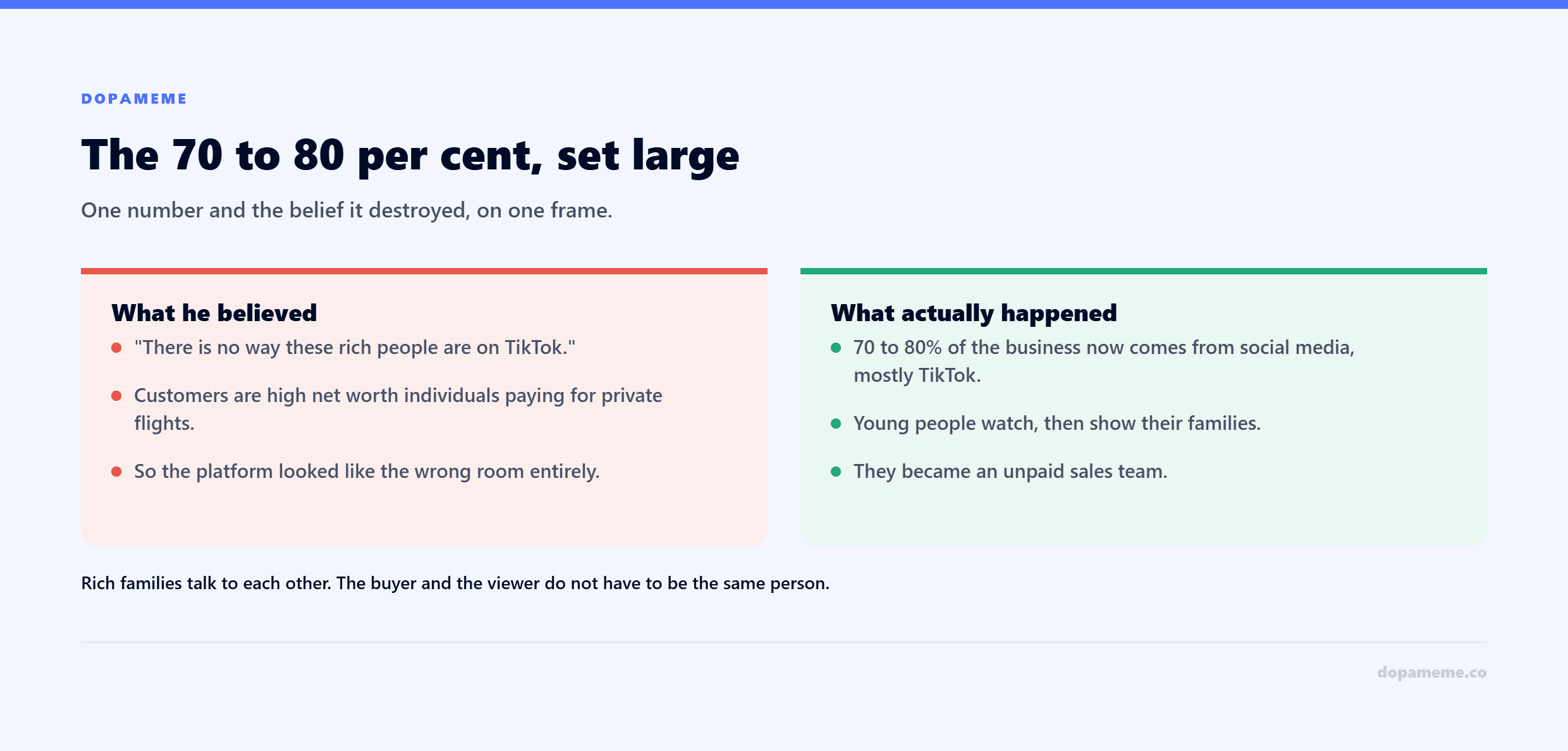
Wealthy private-jet customers are not sitting on TikTok.
He eventually discovered that the assumption was wrong.
But not in the obvious way.
On The 505 Podcast, Jones said more than 70–80% of Amalfi Jets’ business was coming from social media. Immediately afterward, he explained that he had initially resisted TikTok because he could not imagine wealthy people being there.
The twist was that the person watching the TikTok did not always need to be the person buying the flight.
Sometimes the viewer was the buyer’s child.
And that changes how you should think about audience demographics entirely.
Listen to the Amalfi Jets episode of The 505 Podcast
The assumption sounded reasonable
Jones was selling an expensive service.
A private flight is not an impulse purchase.
It is easy to look at TikTok’s demographics and conclude:
Wrong platform.
Wrong audience.
Wrong purchasing power.
And it is true that TikTok remains much stronger among younger Americans.
Pew Research Center’s latest age breakdown says 63% of U.S. adults aged 18–29 use TikTok, compared with 44% of 30–49-year-olds, 30% of 50–64-year-olds and 12% of adults 65+.
See Pew Research Center’s latest TikTok age data
If you stopped the analysis there, Amalfi Jets would look like a weak fit.
Private aviation skews toward wealth.
TikTok skews young.
Case closed.
Except demographic data answers only:
Who is using the platform?
It does not completely answer:
Who can influence the eventual buyer?
The viewer was not always the buyer
This is the most important part of Jones’s explanation.
He described older customers in their 50s and 60s hearing about Amalfi Jets through their children.
In some cases, children told parents or grandparents about a private-jet company they had become obsessed with online.
Those families might have used a traditional private aviation provider for decades.
Then somebody younger inside the household introduced an alternative.
Jones described the dynamic directly on the podcast: the kids discover the company, then tell the parents.
That means the TikTok viewer can have zero ability to purchase a private jet charter themselves and still be commercially valuable.
They can influence somebody who does.
This is where a lot of social-media audience analysis becomes too literal.
Businesses ask:
“Is my customer on this platform?”
Sometimes the better question is:
“Is somebody who talks to my customer on this platform?”
Rich households do not make decisions in isolation
High-ticket buying still happens inside social networks.
Families talk.
Friends recommend.
Employees tell employers.
Children influence parents.
Parents influence children.
Advisers influence clients.
A product can enter the household through a person who will never personally pay for it.
In Amalfi Jets’ case, social media became a discovery layer.
The final customer could be older and wealthier than the median viewer who first encountered the brand.
That breaks the simplest version of demographic targeting.
The audience is not always the market.
Sometimes it is the route into the market.
TikTok was doing one job, not every job
Another useful detail appears later in the same interview.
Jones says Amalfi tracks attribution and platform quality.
His description is more nuanced than “TikTok gets all our business.”
According to Jones:
TikTok generates the most engagement and reaches younger people.
Instagram sits somewhere between younger audiences and actual end users.
YouTube reaches more of the older audience.
That distinction is important.
A company does not need every social platform to perform the same function.
One can create awareness.
Another can provide credibility.
Another can reach buyers more directly.
The commercial system is the combination.
That is also why the accurate claim is:
70–80% from social media.
Not:
70–80% from TikTok alone.
The content did not look like a traditional luxury campaign
This case would be less interesting if Amalfi Jets simply uploaded cinematic shots of Gulfstreams.
Jones explicitly argues against that approach.
In the podcast, he describes using office content, showing the people behind the brand and leaning into authenticity rather than producing only polished aircraft footage.
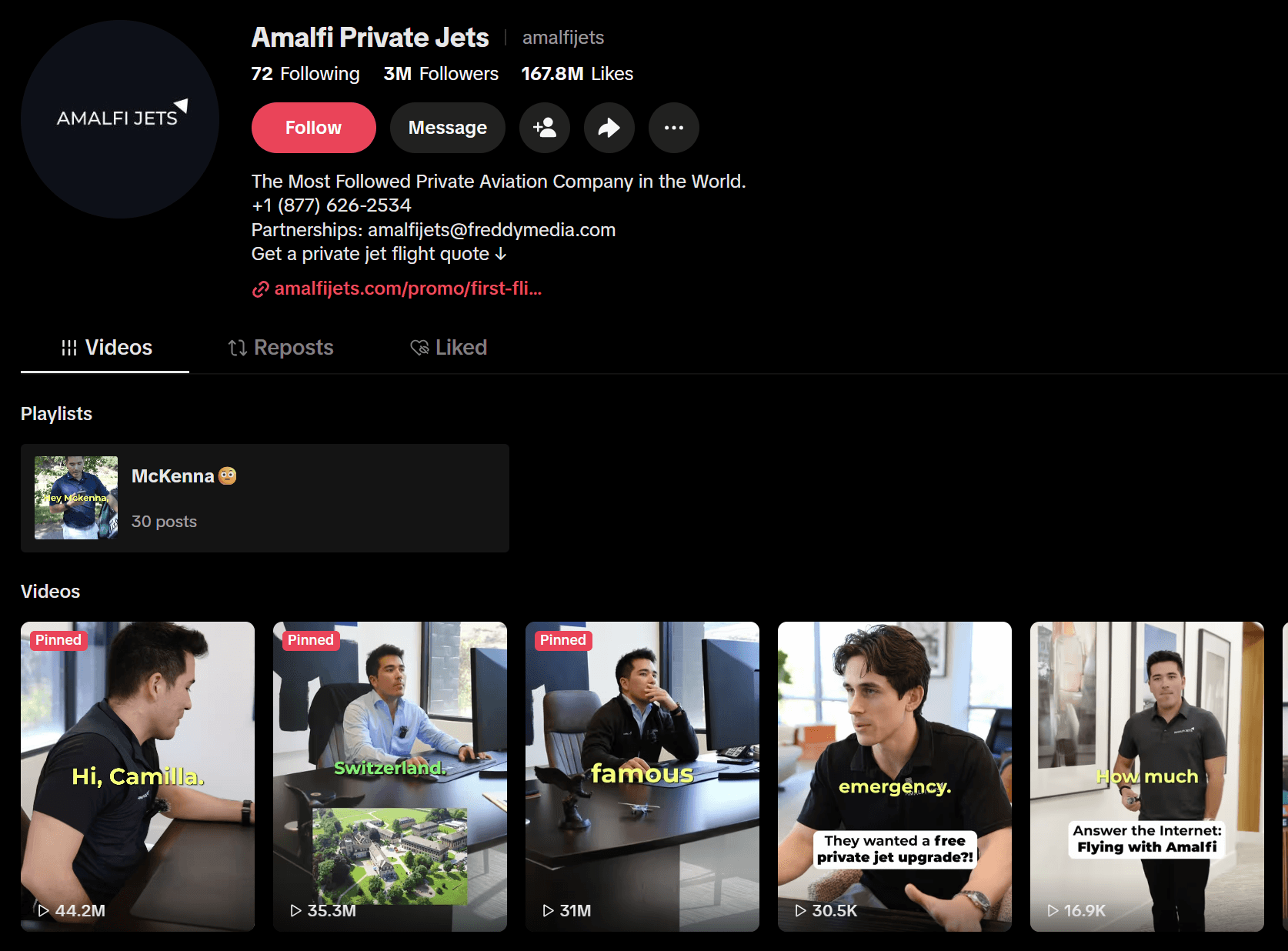
An AeroTime profile of Amalfi Jets describes a similar strategy: social content built around Jones speaking with customers, private-aviation situations, and entertaining behind-the-scenes material. By late 2024, AeroTime reported 1.2 million TikTok followers and more than 32 million likes.
Read AeroTime’s profile of Amalfi Jets’ TikTok strategy
The company’s own website now describes Amalfi Jets as “the most followed private aviation company in the world.”
Visit the official Amalfi Jets website
Why “TikTok is only for young people” is the wrong conclusion
Interestingly, even that stereotype is becoming less absolute.
TikTok is still heavily skewed toward younger users, but Pew reports that 30% of U.S. adults aged 50–64 and 12% of those 65+ used TikTok in 2025.
So some older potential customers are literally there.
But the Amalfi Jets case does not even require that argument.
The stronger lesson is:
You do not need every buyer to use the platform if the platform gives you influence inside the buyer’s world.
That is a more transferable idea.
Would this work for other expensive businesses?
Potentially.
Imagine:
Luxury real estate.
Wealth management.
High-end home construction.
Country clubs.
Specialist healthcare.
Enterprise software.
Luxury travel.
Executive recruiting.
The person watching the first video may not sign the contract.
They can still bring the brand into the conversation.
A twenty-four-year-old employee can introduce software to a sixty-year-old CEO.
A daughter can send a hotel video to her parents.
A junior golfer can show a private club to the person paying the membership.
The social audience can function as an unpaid distribution layer inside households and organizations.
That does not mean every young viewer becomes a salesperson.
It means word-of-mouth does not care whether the original impression came from the final buyer.
This is where demographic data can mislead
Demographic reports are useful.
But they are often treated as destiny.
If your average buyer is 55 and your chosen platform has a younger audience, that does not automatically mean the platform has no commercial value.
You need to map the actual journey:
Who discovers you?
Who remembers you?
Who sends you to somebody else?
Who researches you later?
Who ultimately pays?
Those can be five different people or touchpoints.
Amalfi Jets is an unusually clean demonstration because the product makes the mismatch so obvious.
Private jets are about as far from a mass-market teenage purchase as you can get.
Yet social media became a major source of business.
The platform also became a trust layer
There is another benefit to being repeatedly visible before the buying moment.
Familiarity.
Someone may not need a private jet today.
They might watch Amalfi Jets content for months.
Then a parent needs a charter.
Or their company needs transportation.
Or somebody in their circle asks for a recommendation.
The brand is already mentally available.
Jones repeatedly emphasizes people buying from people and the role of showing the humans behind the company. The 505 Podcast episode frames that creator-led approach as one of Amalfi’s central differentiators.
For a high-ticket business, that may be more valuable than forcing every piece of content to produce an immediate lead.
What high-ticket founders usually get wrong
A common objection we hear at Dopameme is some version of:
“Our buyers aren’t on TikTok.”
Sometimes that is true.
But before deleting the platform from the strategy, I would ask one more question:
Who influences your buyers?
If your customers exist inside families, teams, companies or communities, the person who discovers you may be younger, less wealthy and nowhere near ready to buy.
That person can still move the brand.
The Amalfi Jets case does not prove TikTok will work for every luxury company.
It proves the demographic objection is weaker than it first appears.
The lesson is not “every business needs TikTok”
That would be another bad generalization.
Some companies have tiny addressable markets.
Some products require specialist channels.
Some buyers have almost no relationship to consumer social media.
Some businesses will get far better economics from LinkedIn, search, partnerships or outbound.
The correct lesson is narrower:
Do not reject a platform only because its average viewer does not resemble your final customer.
First understand how information travels to that customer.
Kolin Jones thought rich people were not on TikTok.
His answer after testing was more complicated:
Some were.
Some were not.
Some heard about Amalfi Jets from their kids.
And across the company’s broader social-media engine, that attention became commercially significant enough for Jones to say 70–80% of the business came from social media.
The viewer does not have to be the buyer.
Sometimes the viewer only has to know one.
Sources
The 505 Podcast — How to Make ANY Business Go Viral ft. Kolin Jones
Full searchable transcript of Kolin Jones’s 505 Podcast interview
AeroTime — Leveraging TikTok for a new generation of private jet flyers
Pew Research Center — Americans’ Social Media Use 2025
Pew Research Center — TikTok facts and age breakdown
About the author
Talha Abrar runs Dopameme, an organic social agency focused on the systems behind short-form content, distribution and audience growth.
