
Most short-form hook advice sounds remarkably similar.
Use a number.
Say “you.”
Make a bold statement.
Tell the viewer they are doing something wrong.
Those formats can work.
But in one educational-content dataset we reviewed, they were nowhere close to the strongest format.
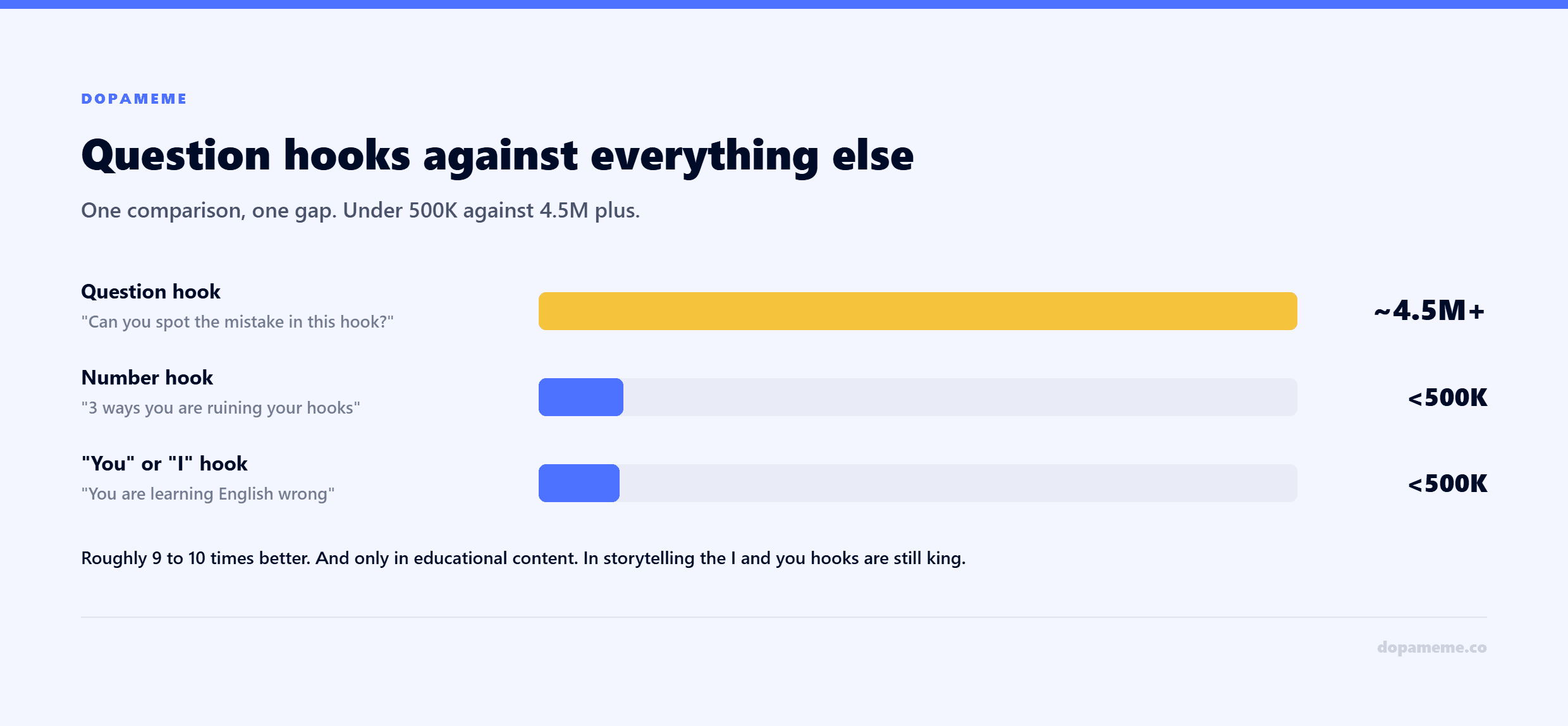
Question-framed hooks averaged roughly 4.5 million+ views.
Number hooks stayed below approximately 500,000 average views.
Hooks built around “you” or “I” also remained below roughly 500,000.
That puts the observed gap at around 9 to 10×.
The useful part is the limitation:
This was educational content.
I would not turn this into “questions are the best hook on social media.”
They were the best-performing format in this particular educational set.
That distinction matters because the reason they seem to work here is tied closely to what educational content asks the viewer to do.
Instead of merely listening, the viewer has to answer.
The numbers: under 500K versus roughly 4.5M+
The comparison is unusually large.
In the content set behind this case:
| Hook format | Observed average performance |
|---|---|
| Question hook | ~4.5M+ views |
| Number hook | <500K views |
| “You” or “I” hook | <500K views |
This is not a randomized experiment.
Different videos contain different subjects, execution, timing and audience conditions.
So we cannot say the grammatical presence of a question caused a ninefold increase.
What we can say is that the question format was the clearest repeated outlier in this educational-content sample.
That makes it worth testing deliberately.
Why standard hook advice did not win here
Number hooks are popular for a reason.
“5 mistakes…”
“3 ways…”
“7 things…”
The structure immediately tells the viewer what they are getting.
Direct-address hooks do something similar.
“You’re pronouncing this wrong.”
“You need to stop doing this.”
They put the viewer inside the sentence.
Both are perfectly reasonable formats.
But educational content has another option that changes the viewer’s role.
Instead of telling them something, ask them something they feel capable of answering.
Compare:
“3 English words you are pronouncing wrong.”
with:
“Can you pronounce all three of these words correctly?”
The first promises information.
The second creates a test.
The video is no longer just something to consume.
The viewer has a task.
Statements close. Questions ask for a response.
The original research note described this through the idea of an “open loop.”
That language is useful if we keep the psychology modest.
A statement can give the viewer a complete thought:
“Here is how to fix your hook.”
Nothing in that sentence requires an immediate response.
Now change it:
“Can you spot the mistake in this hook?”
The viewer can answer before the creator does.
For a moment, watching becomes participation.
Research outside short-form video points in the same general direction.
Two field experiments published in Social Influence found that question headlines produced more readership than declarative headlines in several tested contexts, and questions containing self-referencing cues could perform particularly well. The researchers also found that the effect changed by topic, which is an important warning against treating questions as universally superior.
That is a much better explanation than saying every unanswered question automatically triggers a proven “Zeigarnik effect.”
A 2025 meta-analysis found that the classic claim that unfinished tasks enjoy a universal memory advantage has been difficult to replicate.
For creators, we do not need the stronger psychological claim anyway.
The practical mechanism is enough:
A good question gives the viewer something to mentally do before they have decided whether to scroll.
Active consumption can beat passive consumption
Educational videos often fail because they are formatted like mini lectures.
The creator talks.
The viewer receives.
Every second requires the viewer to decide whether the information is worth continuing to receive.
A challenge-based question changes that relationship.
“Which sentence is correct?”
“Can you hear the pronunciation mistake?”
“What would you choose here?”
“What is wrong with this chart?”
Now the viewer has a reason to stay until the answer arrives.
The content has become interactive without requiring a button, poll or comment.
That matters most when the question is answerable.
A vague question such as:
“Want to learn English?”
does very little.
It technically ends with a question mark, but it gives the brain almost nothing interesting to solve.
The stronger version contains a specific challenge.
The first seconds become a test
The working hypothesis in this dataset is that the question earns a small pause.
Not because “three seconds” is a scientifically established question-hook threshold.
It is not.
But because the viewer needs a moment to understand the challenge and attempt an answer.
That can be enough to change the opening behaviour of the video.
Short-form distribution is highly sensitive to what happens early.
A hook that makes somebody participate immediately has an advantage over one that asks them to wait for value later.
Again, the important word is can.
A bad question is still a bad hook.
The 20-minute TikTok that should not have worked
One of the strangest examples in the source material comes from @captainenglish.
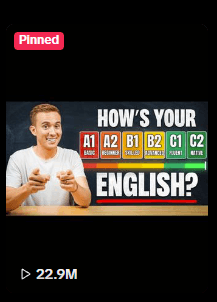
The creator posted an educational TikTok approximately 20 minutes long.
That is almost comically long by normal short-form advice.
TikTok is usually discussed in seconds.
This piece ran for minutes.
And it still travelled.
Source video:
https://www.tiktok.com/@captainenglish/video/7537343694836337950
The useful lesson is not:
“Make every TikTok twenty minutes.”
It is that brevity is not the only route to retention.
If the viewer is actively participating, testing themselves or waiting to resolve a sequence of questions, a video can hold attention far longer than the usual advice would predict.
The interaction is doing work that editing speed normally has to do.
Retention can matter more than brevity
Creators often ask:
“How short should this Reel be?”
That is useful, but it is downstream of a more important question:
Why would someone keep watching?
A boring eight-second video is still boring.
A compelling two-minute test can still hold attention.
A twenty-minute educational video can occasionally work when the viewer is participating throughout it.
Duration creates a cost.
The content has to keep paying that cost with interest.
Questions are one way to do it.
Not because a question mark is magical.
Because a well-designed question repeatedly renews the viewer’s reason to stay.
The hook ladder
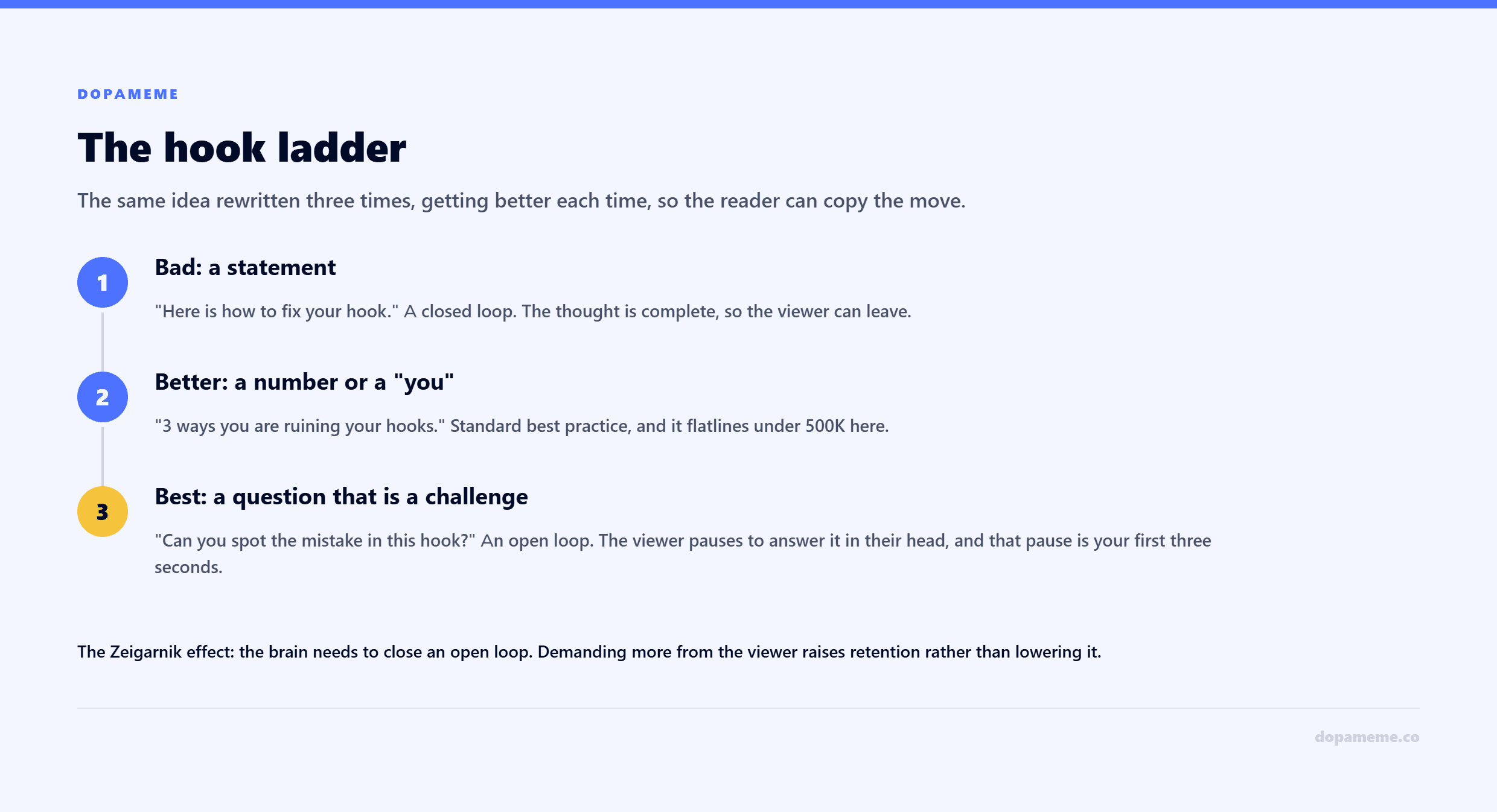
The most practical way to apply the finding is to rewrite one idea three times.
Start with a closed statement.
Then add direct address or a number.
Then turn the idea into a challenge.
Bad: a statement
“Here is how to fix your hook.”
The information is complete.
The viewer knows what the video plans to explain, but there is nothing they need to do yet.
Better: a number or “you”
“3 ways you are ruining your hooks.”
This adds specificity and direct relevance.
It can work perfectly well.
In the dataset behind this article, formats like this still remained far below the question-hook group.
Best for this educational use case: a question that creates a test
“Can you spot the mistake in this hook?”
Now the viewer has a job.
They need to inspect something.
Form an answer.
Then stay long enough to discover whether they were correct.
Five educational hook templates worth testing
You do not need to copy the wording from the examples above.
The structure is what matters.
Spot the error
“Can you find the mistake in this sentence?”
Useful for language, design, marketing, finance, coding and analysis.
Choose between two answers
“Which of these two logos feels more expensive?”
The viewer has to make a decision.
Predict the result
“What do you think happens when I change this one setting?”
The answer arrives later, so the viewer has a reason to stay.
Test existing knowledge
“Do you know what this symbol actually means?”
This works best when the audience has enough knowledge to believe they might know.
Diagnose yourself
“Which of these three mistakes are you making?”
This combines self-reference with a challenge.
The question still needs to match the content.
A hook can earn attention and then destroy trust if the video never resolves it.
Where this strategy stops working
The scope limit on this case is important enough to repeat.
This is educational content.
Question hooks dominated the observed educational set.
That does not mean they should replace every storytelling hook.
Stories often benefit from a completely different opening.
“I lost $40,000 because of one spreadsheet.”
“You have no idea what happened after this client call.”
Those hooks work because the viewer is entering a narrative.
The creator is promising an event, tension or transformation.
Turning every story into:
“Can you guess what happened?”
can make the writing weaker.
The format should match the content.
Education naturally supports tests.
Storytelling naturally supports narrative.
Do not use a winning tactic outside the conditions that made it win.
What I would test next
If you create educational short-form content, take five existing scripts.
Do not reshoot them yet.
Rewrite only the hook.
Version A: statement.
Version B: number or direct address.
Version C: challenge-based question.
Then test them across enough posts to get something better than a sample size of one.
Track the outcome.
Views are useful.
But also watch retention, completion, saves and comments.
The goal is not to prove that questions always win.
The goal is to discover whether your audience behaves like the audience in this dataset.
Because if it does, the difference is too large to ignore.
The useful lesson from 4.5 million views
The headline number is dramatic:
~4.5M+ versus under 500K.
But I would not turn that into:
“Question hooks get nine times more views.”
The evidence does not support a universal claim.
The better conclusion is:
In educational short-form content, questions are worth testing as a distinct hook category because they can turn the opening from information into participation.
Numbers tell the viewer what they will receive.
“You” tells them the information is relevant.
A good question gives them something to do.
That difference may be small grammatically.
In this dataset, the performance difference was not.
Sources
@captainenglish, TikTok
20-minute interactive educational video:
https://www.tiktok.com/@captainenglish/video/7537343694836337950
Dopameme educational hook-format analysis
Question hooks: approximately 4.5M+ average views.
Number and “you/I” formats: below approximately 500K average views in the captured dataset.
Lai, Linda & Farbrot, Audun.
What makes you click? The effect of question headlines on readership in computer-mediated communication.
Social Influence, 2014.
Ghibellini, Romain & Meier, Beat.
Interruption, recall and resumption: a meta-analysis of the Zeigarnik and Ovsiankina effects.
Humanities and Social Sciences Communications, 2025.
About the author
Talha Abrar runs Dopameme, an organic social agency focused on the systems behind short-form content, distribution and audience growth.
