
Most creators spend a lot of time making sure nobody can correct them.
Fix the typo.
Double-check the facts.
Remove the awkward edit.
Make the answer defensible before it reaches the comments.
Two viral posts in this case study did almost the opposite.
One deliberately gave viewers terrible answers to a couples game.
The other showed a glow-up so obviously fake that people rushed into the comments to call it out.
At the time these posts were captured, the results were:
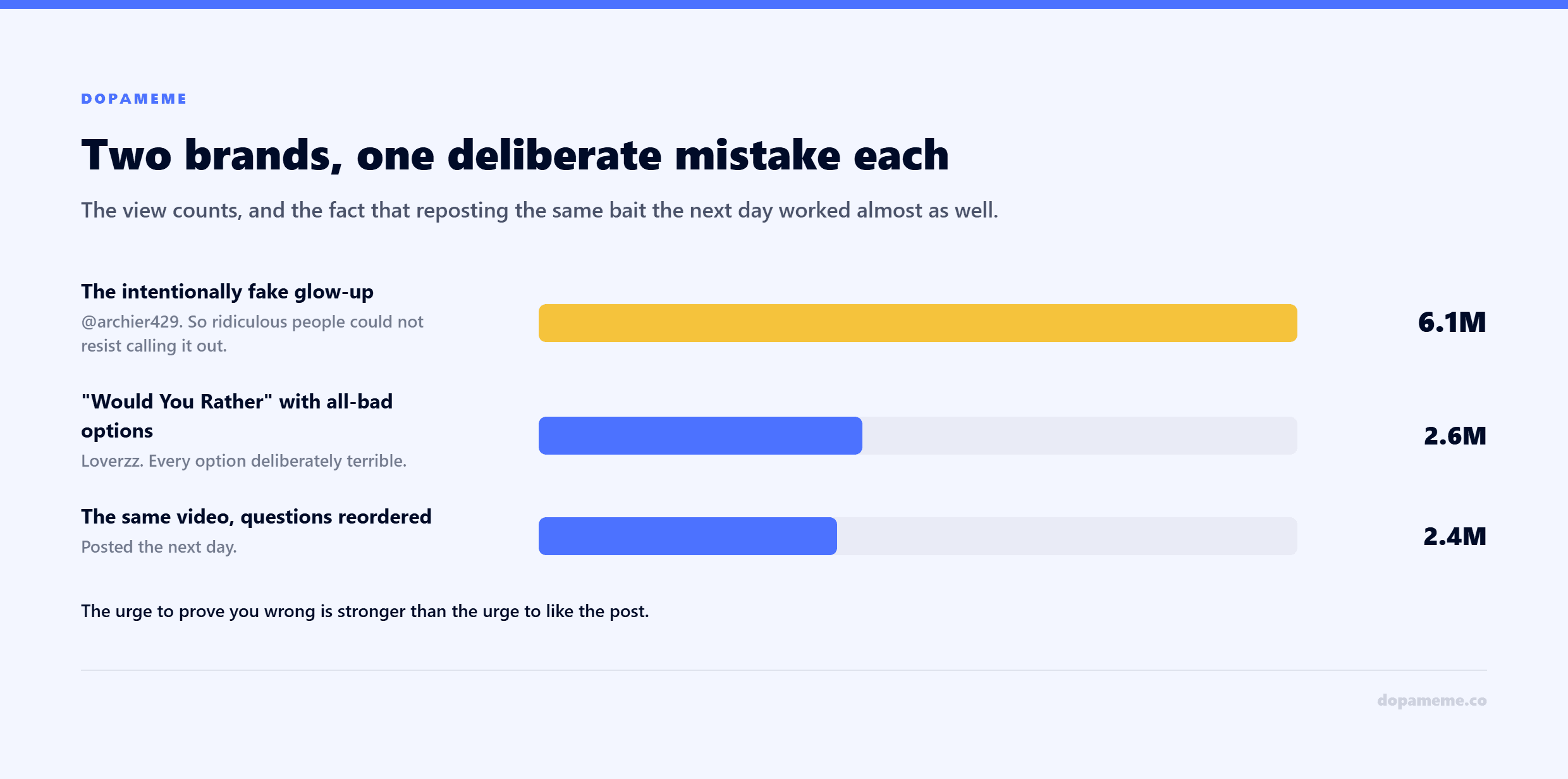
2.6 million views.
6.1 million views.
Then the first account took essentially the same bait, rearranged the questions, posted it again the next day and pulled another 2.4 million views.
The mistakes were not something the audience happened to discover.
They were the mechanism.
The common thread is uncomfortable but useful to understand:
The urge to prove somebody wrong can be stronger than the urge to simply like their post.
That does not mean brands should deliberately make audiences angry.
It means correction itself can become a form of participation.
What rage bait actually is
Oxford University Press named “rage bait” its 2025 Word of the Year and defines it as online content deliberately designed to provoke anger or outrage, typically to increase traffic or engagement.
Read Oxford University Press’s definition of rage bait
That definition covers a huge spectrum.
At one end:
A creator deliberately leaves one annoying spot uncleaned in a satisfying cleaning video.
At the other:
Someone spreads inflammatory misinformation about politics, health, identity or a real person because anger produces replies.
Those are not ethically equivalent.
The cases in this article sit closer to what I would call correction bait.
The mistake is conspicuous.
The audience can recognize it.
And noticing the mistake gives people something immediate to say.
Case 1: Loverzz made every choice frustrating on purpose
The couples app Loverzz used a familiar short-form format:
Would You Rather?
Normally, the game works because the audience has to choose between two legitimate options.
Loverzz made the choices frustrating for a different reason.
The options were intentionally bad.
The audience could see it.
People started correcting, arguing and explaining what the choices should have been.
The original post was captured at approximately 2.6 million views.
You can see the public creator account here:
View @ariellelovezzdylan on TikTok
One result could still be an outlier.
What happened next makes the case more useful.
They reposted the bait the next day
Instead of abandoning the format, the creators used essentially the same idea again.
They reordered the questions.
Then posted it the following day.
The repost reached approximately 2.4 million views in the captured evidence.
View the reordered Loverzz TikTok repost
That does not prove the intentionally bad answers caused 2.4 million views.
TikTok does not distribute two uploads to identical audience samples.
Timing differs.
Early viewers differ.
Recommendation paths differ.
But the repeat matters.
The irritating choices were not an accident removed after the first post.
They remained central to the second.
A separate public teardown by Social Growth Engineers later documented Loverzz using the same rage-bait question format across multiple million-view posts, adding independent evidence that this was a repeated creative system rather than a single strange upload.
Read the independent Loverzz rage-bait teardown
The comments were doing more than the likes
The view count is the easiest number to screenshot.
The comments explain the mechanic.
Viewers were not only watching.
They were correcting.
Disagreeing.
Pointing out how ridiculous the answers were.
Explaining what the creator should have chosen.
A like takes almost no thought.
A correction requires the viewer to formulate a response.
That turns the audience from spectators into participants.
And once enough people participate, the comment section becomes another piece of content beneath the video.
A new viewer sees the post.
Then sees hundreds of people arguing underneath it.
Now there are two things to consume:
The video.
And everybody’s reaction to the video.

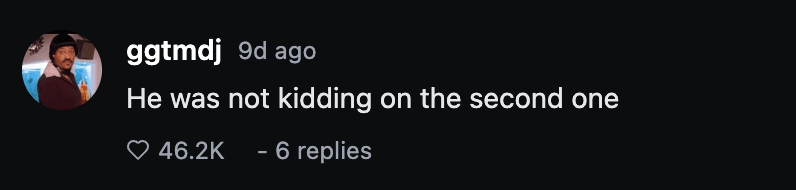
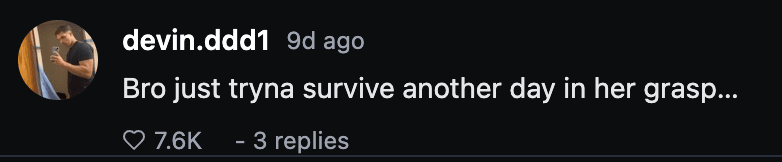
The correction is the engagement mechanic. Viewers are not being asked to “comment below”; the deliberately wrong content gives them something they already want to say.
Case 2: the glow-up was fake enough to invite correction
The second case came from @archier429.
The post used one of the oldest internet formats:
Before.
After.
Glow-up.
Except the transformation was intentionally ridiculous.
The point was not to create a convincing transformation.
The point was that viewers could spot what was wrong.
The post was captured at approximately 6.1 million views.
View the @archier429 TikTok post
People responded exactly where the creative gave them an opening.
They called it fake.
They mocked the difference.
They explained why it was wrong.
They effectively told the creator:
You are not fooling us.
That is an interesting emotional position to give the viewer.
They feel one step ahead of the post.
Why anger can travel
There is broader research suggesting that the underlying emotional mechanism is not completely unique to TikTok.
Jonah Berger and Katherine Milkman’s study “What Makes Online Content Viral?” found that virality was associated not simply with whether content was positive or negative, but with high-arousal emotion. Anger and anxiety were associated with greater transmission, while lower-arousal emotions such as sadness were associated with less.
Read Berger and Milkman’s study in the Journal of Marketing Research
That study does not prove that deliberately inserting an error into a Reel will increase reach.
Different platform.
Different content.
Different behavior.
But it helps explain why emotionally activating content can travel differently from content that produces little reaction.
The important word is not necessarily negative.
It is activating.
Correction bait gives the viewer an action to take.
The rule is not “make people angry”
The lowest-risk version of this mechanism has two characteristics:
Harmless.
And:
Obvious.
Imagine a satisfying cleaning video where the creator deliberately misses one tiny visible spot.
Everyone can see it.
People comment because it annoys them.
Nobody makes a meaningful real-world decision based on the mistake.
That is completely different from posting false medical information because doctors will correct you.
Or deliberately misrepresenting a financial fact because investors will argue.
Or accusing a real person of something inflammatory because their defenders will flood the comments.
The engagement mechanic may look similar.
The consequences are not.
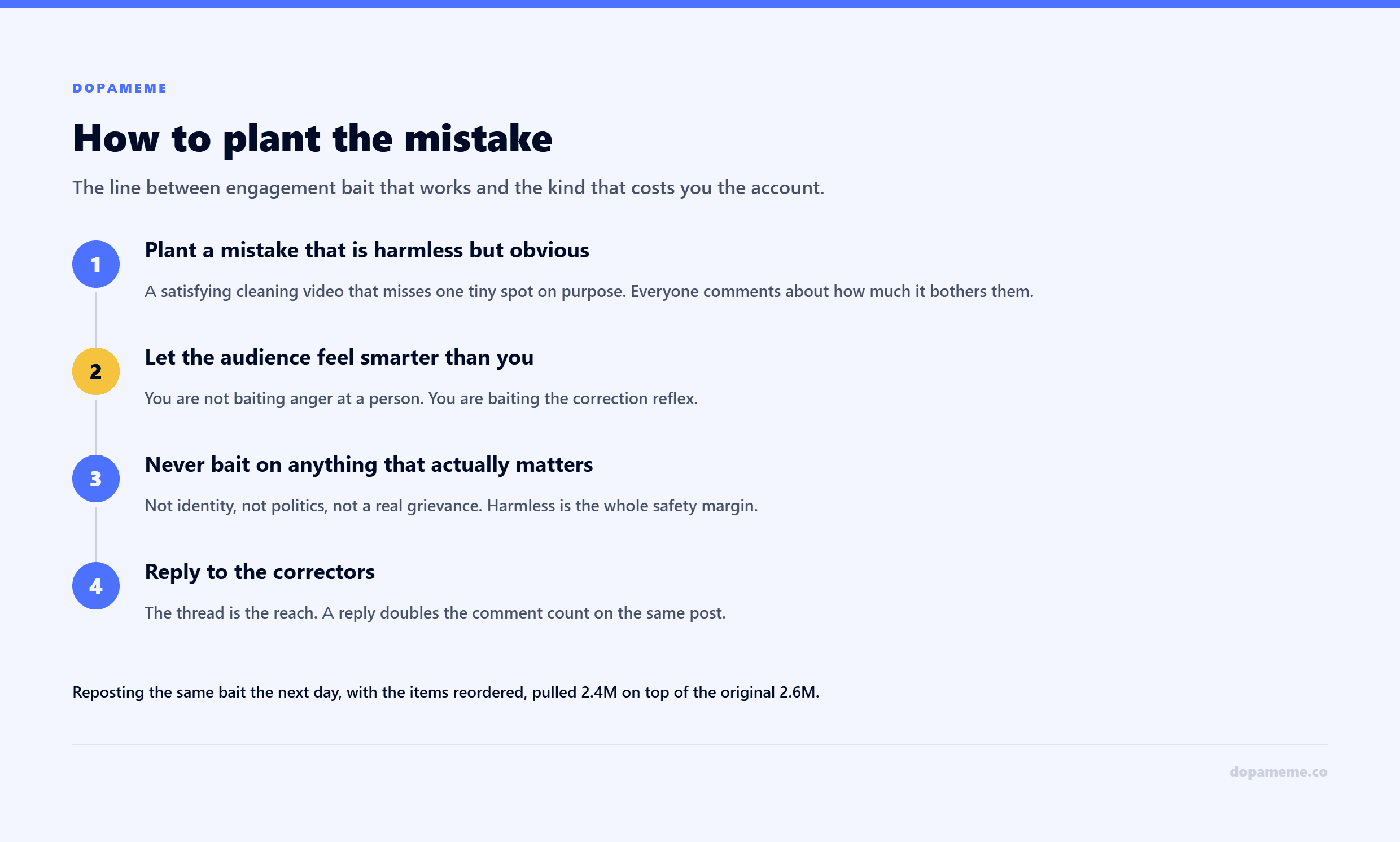
The only defensible version of deliberate-error content is low-stakes and visibly artificial. The moment the mistake can genuinely mislead people, the tactic stops being a joke.
Obviousness is the safety margin
If the audience needs to genuinely believe the false claim for the content to work, you no longer have correction bait.
You have misinformation.
That distinction matters.
An absurd ranking can be funny.
An incorrect dosage is dangerous.
Leaving one spot dirty is irritating.
Making a false allegation about a person can send thousands of strangers toward them.
A deliberately terrible “Would You Rather?” choice disappears when the viewer scrolls.
A false claim about what your product can do can become a screenshot that follows the company for years.
The mistake should never matter more than the engagement it creates.
There is another version inside the comments
A deliberate friction point does not have to appear in the video itself.
In a separate captured case, a provocative pinned comment underneath an already-viral post generated roughly 2,000 replies to that one comment thread.
The principle was similar.
Instead of creating a new video hook, the account gave viewers another statement to push against inside the comments.
That can extend the life of an already-busy conversation.
But it carries the same risk.
If the comment turns a real person, private dispute or consequential false claim into bait, the cost is much higher than another thousand replies are worth.
Source note: the original public URL for this supplementary pinned-comment example was not preserved in the research archive, so I am not linking to an unverified post. The captured screenshot can be reproduced as evidence if you choose to include it.
Does rage bait work on Instagram?
The evidence in this particular article is TikTok evidence.
That distinction matters.
These cases do not prove that uploading the same type of deliberate mistake to Instagram will reproduce the same view counts.
And I would be careful about framing explicit engagement manipulation as a safe Meta-platform growth strategy.
Meta has previously documented that it demotes explicit engagement bait on Facebook—posts designed to manufacture likes, comments and shares purely to game reach.
Read Meta’s official engagement-bait announcement
That Facebook policy is not evidence that Instagram treats every correction-style Reel identically.
It is evidence that Meta has historically distinguished between authentic participation and engagement manufactured specifically to game distribution.
So if the question is:
“Does rage bait work on Instagram?”
The defensible answer is:
It can certainly provoke comments, but these cases do not establish an Instagram reach multiplier, and I would not treat deliberate engagement manipulation as a durable Instagram strategy.
When rage bait becomes a bad idea
The first cost is obvious.
Trust.
If every post contains a mistake, eventually the audience stops believing it was a mistake.
They understand the game.
Now you are no longer the creator they enjoy correcting.
You are the creator constantly pretending to be stupid for comments.
That becomes exhausting.
The second cost is audience quality.
Content teaches people how to interact with you.
If every successful post rewards mockery, outrage and correction, you may build an audience that arrives primarily to mock, outrage and correct.
Those people still count in the analytics.
That does not mean they are useful customers, supporters or community members.
The third cost is escalation.
Once one harmless mistake produces strong numbers, the temptation is to make the next one more extreme.
Then more controversial.
Then more personal.
That is where a creative device turns into an editorial identity.
The version that ages better
There is a cleaner way to use the underlying insight.
Give people something real to disagree with.
Take an actual position.
Rank five tools and explain why number one won.
Challenge an industry assumption.
Compare two strategies.
Make a prediction.
Publish a conclusion somebody intelligent could reasonably reject.
That still activates the correction reflex.
But when somebody says:
“You’re wrong.”
you can answer:
“Here’s why I think I’m right.”
Now the disagreement improves the content instead of revealing that the entire thing was a trap.
Why we don’t run this play for Dopameme clients
We study cases like these because they reveal how attention behaves.
That does not mean we copy every mechanism we study.
At Dopameme, we do not build client strategies around deliberate rage bait.
The short-term engagement can be real.
So can the long-term cost.
We would rather give the audience a strong position to challenge than a fake mistake to correct.
A position can build authority.
A trap mostly builds another comment.
What the 2.6M, 2.4M and 6.1M cases actually tell us
They do not prove:
Rage bait always goes viral.
They do not prove:
The algorithm rewards mistakes.
They do not prove:
Anger guarantees reach.
They show something narrower.
Correction is participation.
The Loverzz post reached approximately 2.6M views.
Its reordered follow-up reached approximately 2.4M.
The exaggerated glow-up reached approximately 6.1M.
The audience had a strong reason to respond in all three.
That is the lesson worth keeping.
Not:
Make people angry.
But:
Give people a reason to participate that feels stronger than tapping like.
Then make sure that reason is one you are willing to build a brand around.
Sources
Loverzz / @ariellelovezzdylan — public creator account:
View the Loverzz creator account on TikTok
Loverzz reordered repost — approximately 2.4M in the captured case:
View the reordered TikTok post
Social Growth Engineers — independent teardown documenting Loverzz’s repeated rage-bait question format and multiple million-view posts:
Read “17M Views on Rage Bait Questions”
@archier429 — deliberately exaggerated glow-up example:
View the 6.1M case post on TikTok
Oxford University Press — definition and 2025 Word of the Year analysis:
Read “The Oxford Word of the Year 2025 is rage bait”
Berger, Jonah & Milkman, Katherine L. — What Makes Online Content Viral?, Journal of Marketing Research:
Read the academic study
Meta — official documentation on Facebook engagement-bait demotion:
Read “Fighting Engagement Bait on Facebook”
About the author
Talha Abrar runs Dopameme, an organic social agency focused on the systems behind short-form content, distribution and audience growth.
