
Most creators treat the first result of a Reel as a verdict on the creative.
Post it once.
It underperforms.
Move on.
In June 2026, CatGPT did almost the opposite.
The account posted the same “people pleasing” footage four times as Instagram Trial Reels, using a different caption on each run.
The footage stayed the same.
The results did not.
| Trial | Result |
|---|---|
| Caption #1 | 116×, reaching 14.1 million views |
| Caption #2 | 13× |
| Caption #3 | 10×+ |
| Caption #4 | 9× |
Every run was an outlier.
Even the weakest version reached roughly nine times the account’s normal performance.
The largest reached 14.1 million views.
A separate follow-up video about the winning Reel became an 11× outlier itself.
It would be easy to look at those results and decide Caption #1 caused the 116× run.
The experiment does not prove that.
The initial audiences were not controlled. Timing may have differed. Early watch behaviour and sharing may have differed. Instagram may have taken each upload through a different recommendation path.
What the experiment shows is narrower, but more useful:
One upload is not necessarily a reliable measurement of the full potential of the creative underneath it.
What Trial Reels change
A normal repost has an obvious problem.
Your existing followers may see the same thing again.
Trial Reels were designed differently.
Instagram says Trial Reels are shown to non-followers first. During the trial, they are not shown to other people on the creator’s main grid or Reels tab, and followers normally will not receive them in Feed or the Reels tab unless the creator later shares the Reel with everyone.
Followers can still encounter one indirectly, such as through a DM or a page associated with the same audio, location or filter.
That changes the cost of retesting a piece of content.
A creator can give an idea another chance with people outside the existing audience without intentionally serving the same post to every follower again.
That is why reposting a Trial Reel is different from publishing the same Reel to your normal feed four times.
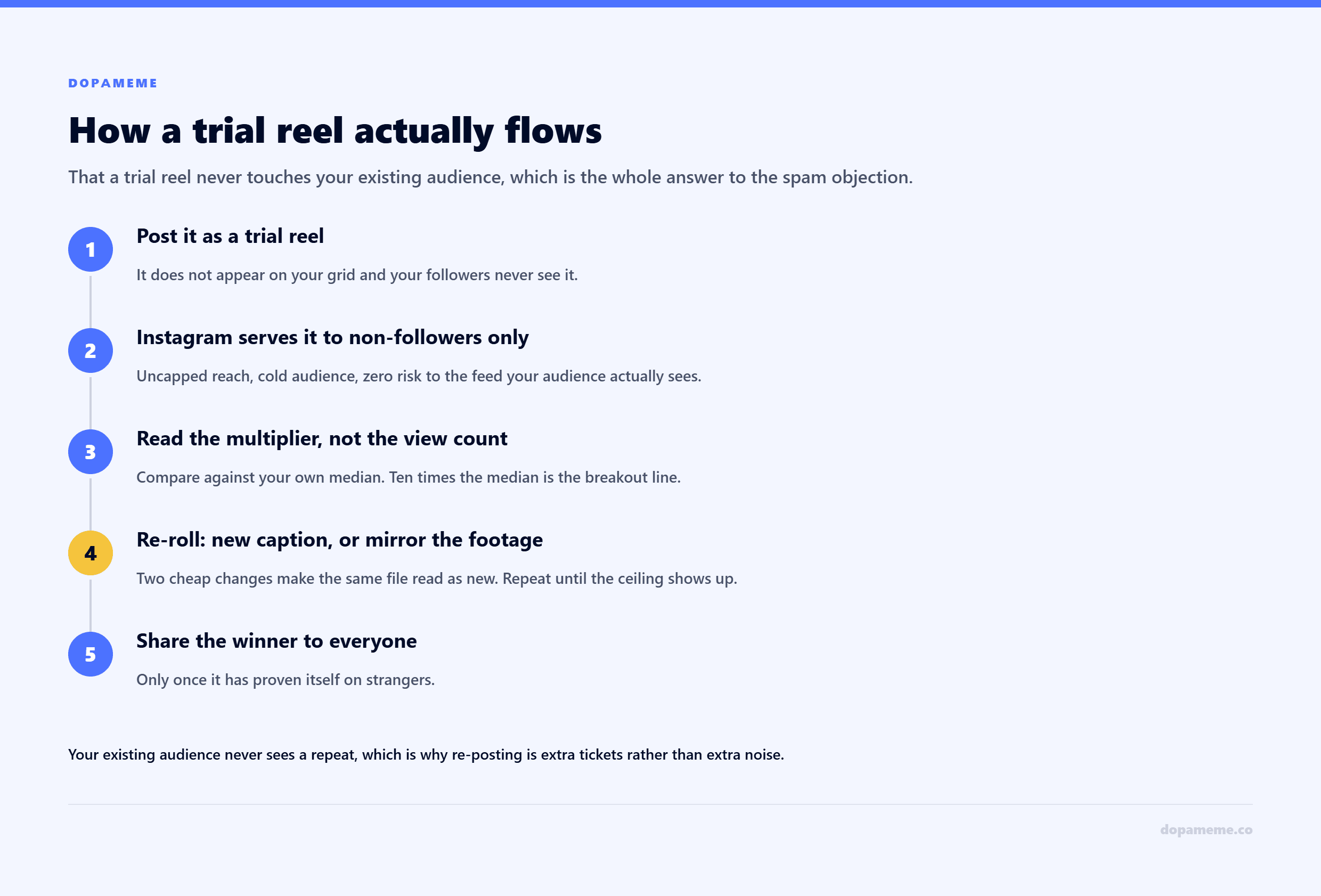
Trial Reels begin with non-followers. A successful test can later be shared with everyone.
The CatGPT experiment
These are the four original CatGPT posts.
116×, 14.1M views
https://www.instagram.com/p/DZIUsE5CW2e/
13×
https://www.instagram.com/p/DZIb1xjCg02/
10×+
https://www.instagram.com/p/DZIVNK7o2Ox/
9×
https://www.instagram.com/p/DZIVcvlCFRq/
And the follow-up video about the winner:
11×
https://www.instagram.com/p/DZLwZ3cCVyh/
These were not four unrelated concepts.
The core creative was the same.
That gives us a better question than “which caption won?”
Why could essentially the same creative receive such different distribution?
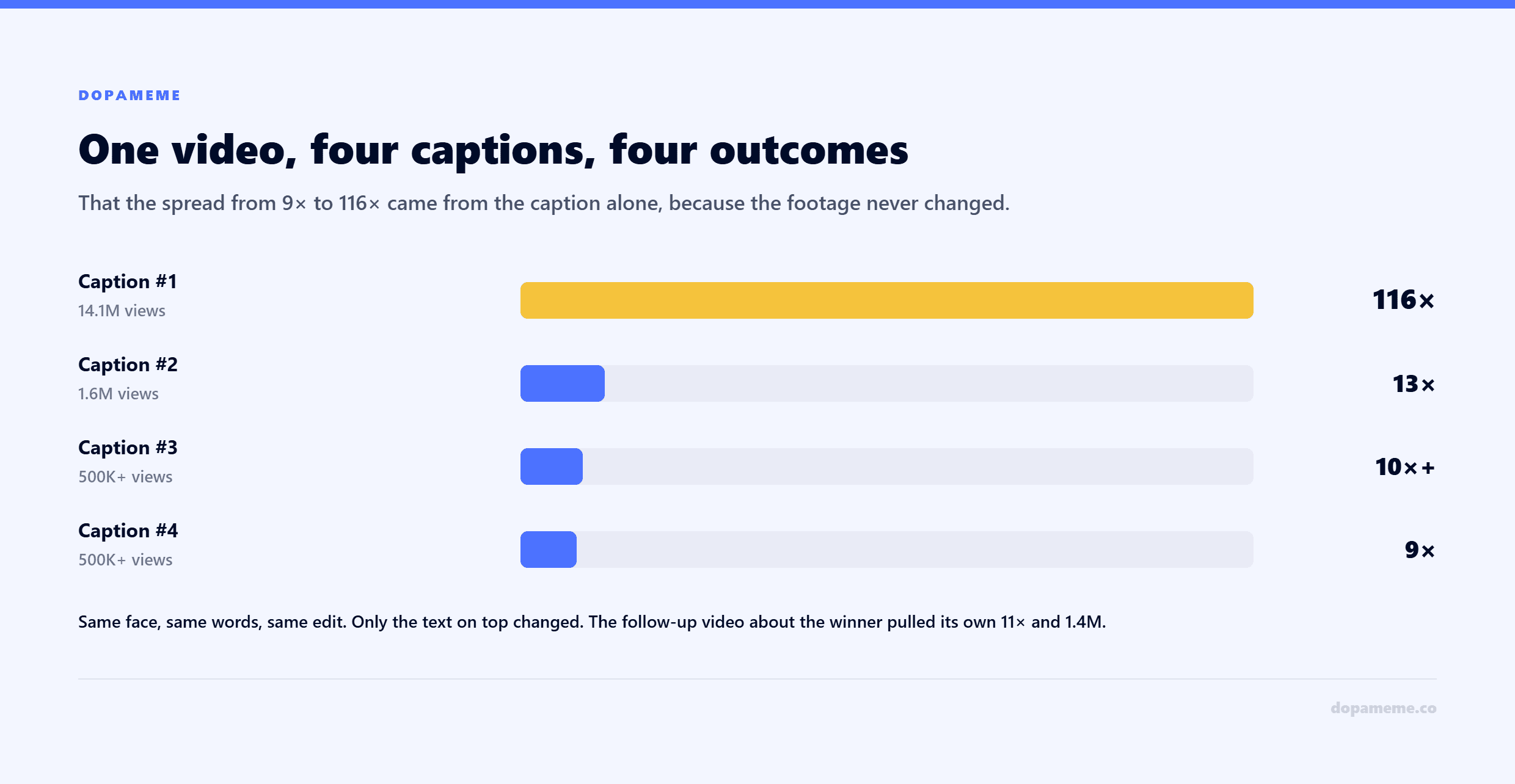
One upload is one sample
Instagram does not send every Reel through an identical audience path.
Trial Reels make this especially obvious because they are designed to test content with people who do not already follow the account.
Imagine one upload reaches an early audience that watches but rarely shares.
Another reaches people for whom the subject is unusually relevant.
They stay longer.
More of them send it.
More of them interact.
Instagram now has a different set of signals from the second test.
That is a plausible reason two runs of the same underlying idea can travel very differently.
It is not proof of exactly what happened inside CatGPT’s account.
We cannot see the complete recommendation path for each upload.
We can only see the inputs and outputs.
The creative remained unusually stable.
The outcomes did not.
The caption did not necessarily cause 14.1 million views
Four captions were used.
One version reached 14.1 million views.
That does not establish a causal relationship between that caption and the 116× result.
There was only one run of each version.
The initial viewers were different.
The posts may have gone live at different times.
Early engagement was not controlled.
Other variables may have changed without being visible publicly.
To isolate the caption itself, you would need repeated tests under much more controlled conditions.
The claim we can defend is simpler:
The same underlying footage produced four separate outliers when retested through Trial Reels.
That is enough to make the case interesting.
The mirror test produced another pair of outliers
CatGPT was not the only account in the proof stack.
Creator Cooper Simson reused the same “Analyze Any Stock Price” Reel with a new caption and horizontally mirrored footage.
The microphone moved from one side of the frame to the other.
Most of the underlying creative remained intact.
One version reached approximately 16× normal performance and 284,000 views.
The other reached roughly 5× to 6×.
The two posts:
https://www.instagram.com/p/DY6Rlhmt66h/
https://www.instagram.com/p/DZLvPlIP5gk/
Again, we cannot claim the mirror flip caused the difference.
The caption changed too.
The audience test changed.
Potentially other variables changed.
What it shows is that an existing creative does not necessarily have only one possible distribution outcome.
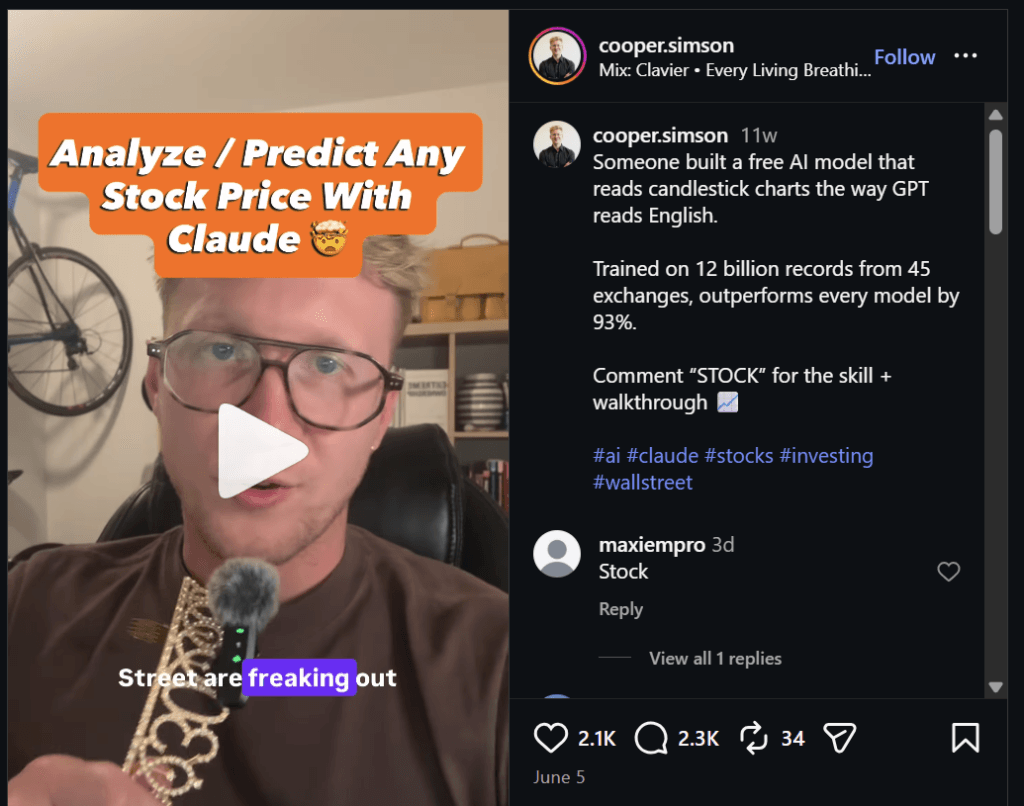

More accounts produced large Trial Reel outliers
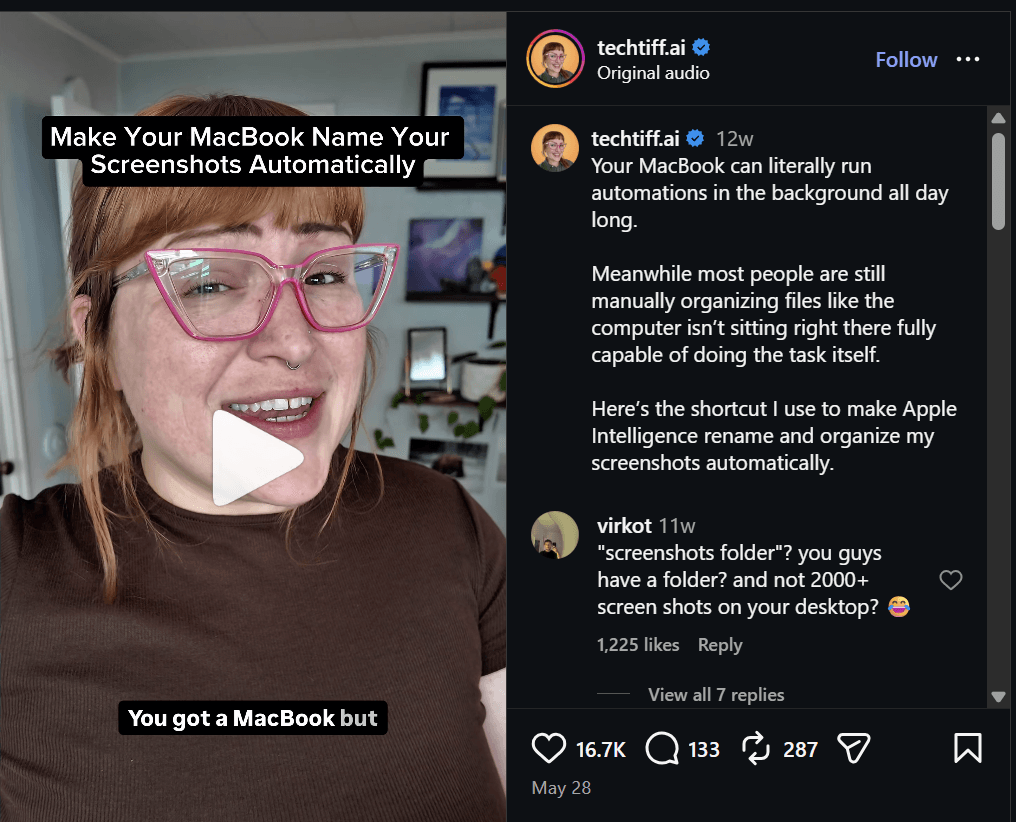
There are two additional examples from techtiff.ai.
One Trial Reel was recorded at approximately 14×:
https://www.instagram.com/p/DYvwezEOS4t/
Another reached roughly 9×:
https://www.instagram.com/p/DY24RFaShrr/
These do not prove that Trial Reels always outperform standard posts.
They add more examples to the same pattern: the feature can expose content to a much larger non-follower audience when a test catches.
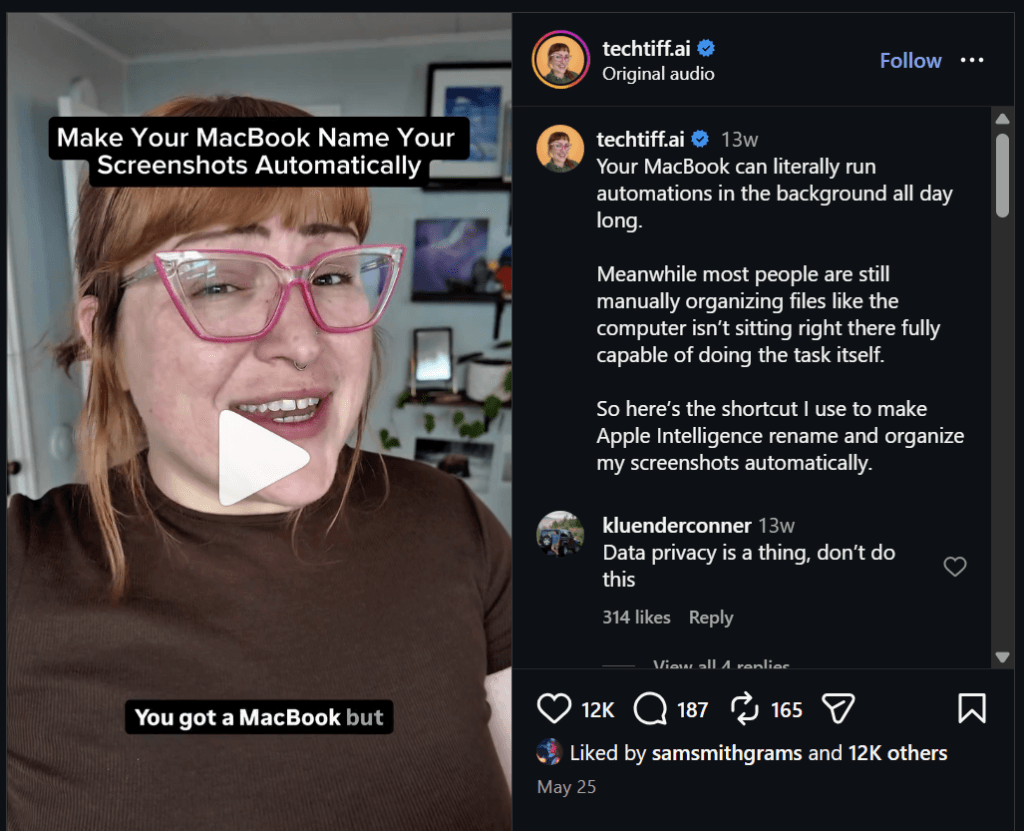
Instagram’s own numbers support more experimentation
Meta later analysed more than 400,000 creators who were already producing Reels.
After trying Trial Reels, 40% began posting Reels more frequently.
Among the creators who increased their posting frequency, 80% saw an increase in Reel reach from non-followers.
Meta also states that the result does not guarantee that every individual creator will experience the same outcome.
That caveat matters.
Trial Reels are not a button that guarantees more reach.
They reduce the audience cost of experimentation.
Do Trial Reels still work in 2026?
Yes.
The feature still gives creators a way to test content with non-followers before deciding whether to share it more broadly.
What has become less dependable is the idea that you can upload an identical file indefinitely and change almost nothing.
Creators in 2026 have reported receiving warnings that a Trial Reel:
“Looks similar to something you’ve posted before.”
Some report reduced non-follower distribution after receiving the warning.
Instagram has not publicly documented the exact similarity threshold, so those creator reports should be treated as anecdotal rather than a technical specification of the ranking system.
But they are useful enough to change the practical recommendation.
I would not turn the CatGPT experiment into this rule:
“Change the caption and Instagram will always treat the Reel as new.”
The evidence does not support that.
Retest the idea, not just the file
If a concept has already demonstrated that people care about it, throwing the entire thing away after one run wastes information.
Keep the central idea.
Then create another legitimate version.
Change the opening hook.
Use different on-screen text.
Recut the first few seconds.
Change the framing.
Try different audio.
Use another caption.
Mirror the footage if the composition still works.
The aim is not to trick Instagram’s duplicate-content systems.
The aim is to preserve the strongest part of a proven creative while creating another useful test.
Is reposting the same Reel spam?
This is where Trial Reels change the answer.
A client sees the same creative being uploaded again and asks:
“Why are we posting this again? Isn’t that too much?”
That objection makes sense if four normal posts are being pushed to the same followers.
A Trial Reel begins differently.
Instagram specifically introduced the format so creators could experiment with non-followers before deciding whether to share the content with their existing audience.
The strategy is therefore closer to running another creative test than repeatedly showing every follower the same post.
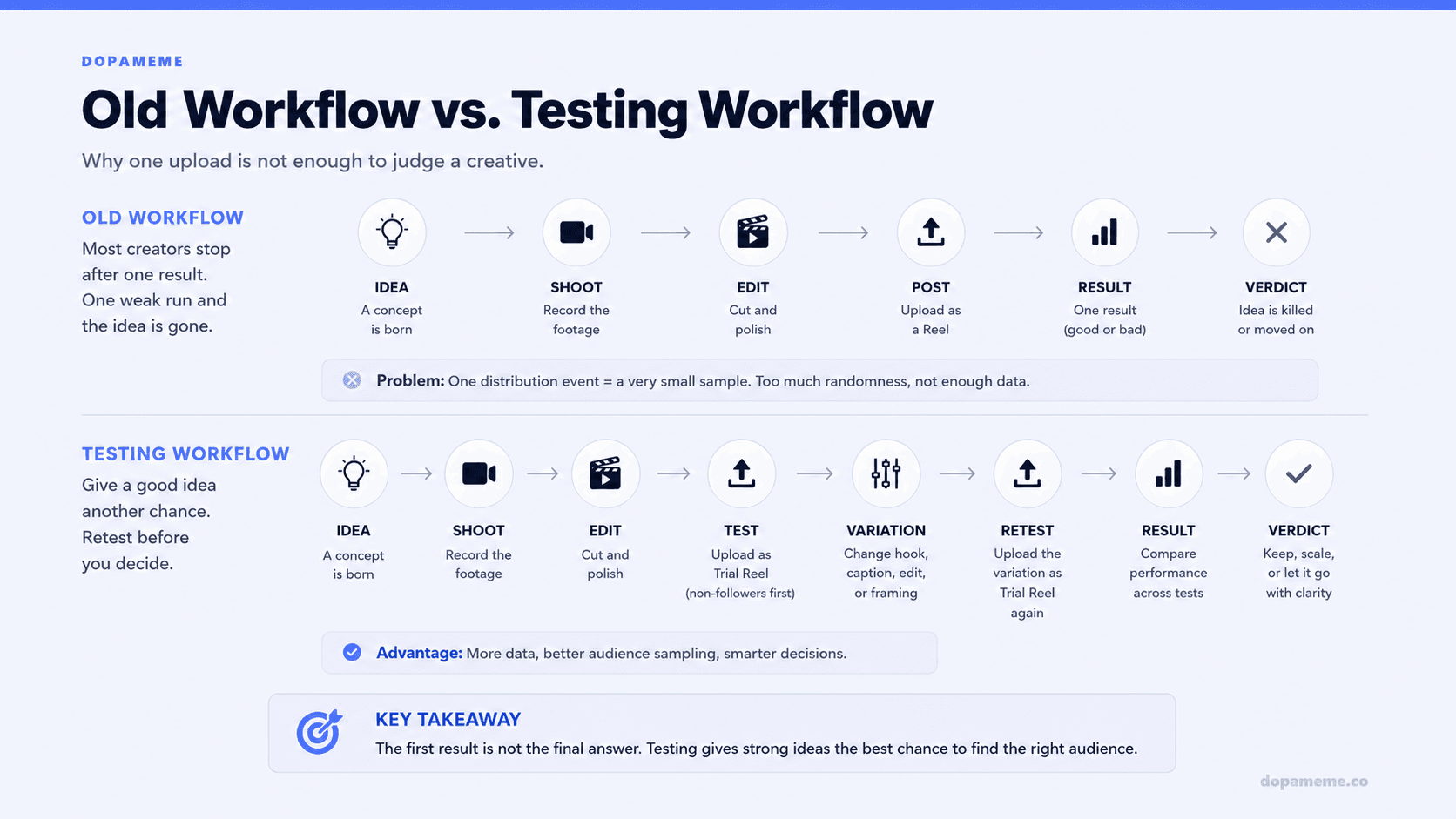
The workflow most creators use is too final
A normal content workflow looks like this:
Idea → shoot → edit → post → result → verdict
One weak result and the idea disappears.
Trial Reels make another workflow possible:
Idea → shoot → edit → test → variation → retest → verdict
That does not mean every weak Reel deserves ten more uploads.
Repeated failure is useful information too.
But one poor distribution run is a very small sample.
Why some Reels go viral the second time
Sometimes the creative did not change very much.
The audience did.
The early response did.
The recommendation path did.
Timing may have changed too.
Creators usually see only the final view count, so all those variables get compressed into one conclusion:
“This Reel worked.”
Or:
“This Reel failed.”
The CatGPT experiment is useful because the underlying footage remained unusually stable while the outcomes changed enormously.
The 9× version was already a success.
The 116× version reached 14.1 million views.
Content quality and distribution outcome are connected.
They are not the same thing.
The 14.1 million-view lesson
The wrong conclusion from this case is:
“A new caption can turn any Reel into 14 million views.”
The experiment cannot support that claim.
The useful conclusion is:
One upload is not enough evidence to know the full potential of a strong creative.
CatGPT ran essentially the same footage four times.
The recorded results were:
9×
10×+
13×
116×
The largest run reached 14.1 million views.
Instagram appears to be getting stricter about very similar Trial Reel uploads, so I would not copy the June tactic literally and assume a caption change will always be enough.
I would copy the principle.
When an idea has evidence behind it, do not automatically kill it because one upload got the wrong result.
Change something meaningful.
Test it again.
Then decide.
Sources
CatGPT / @askcatgpt
116× / 14.1M views
https://www.instagram.com/p/DZIUsE5CW2e/
13×
https://www.instagram.com/p/DZIb1xjCg02/
10×+
https://www.instagram.com/p/DZIVNK7o2Ox/
9×
https://www.instagram.com/p/DZIVcvlCFRq/
11× follow-up
https://www.instagram.com/p/DZLwZ3cCVyh/
Cooper Simson
16× / approximately 284K views
https://www.instagram.com/p/DY6Rlhmt66h/
5–6× variation
https://www.instagram.com/p/DZLvPlIP5gk/
techtiff.ai
14× Trial Reel
https://www.instagram.com/p/DYvwezEOS4t/
9× Trial Reel
https://www.instagram.com/p/DY24RFaShrr/
Instagram / Meta
Test Content With Non-Followers Using Trial Reels, December 2024.
https://about.fb.com/news/2024/12/trial-reels-try-content-non-followers-first-see-what-perfoms-best/
Meta’s Trial Reels creator analysis, including the 40% and 80% figures.
https://about.fb.com/news/2025/06/inspiring-creativity-that-brings-people-together/
2026 Trial Reel similarity-warning reports
Used only as anecdotal evidence for the current duplicate-content caveat.
https://www.reddit.com/r/InstagramMarketing/comments/1sk57fw/recent_change_to_trial_reels/
About the author
Talha Abrar runs Dopameme, an organic social agency focused on the systems behind short-form content, distribution and audience growth.
