
Most brands have one Instagram account.
Maybe a TikTok too.
BuildCores took a very different approach.
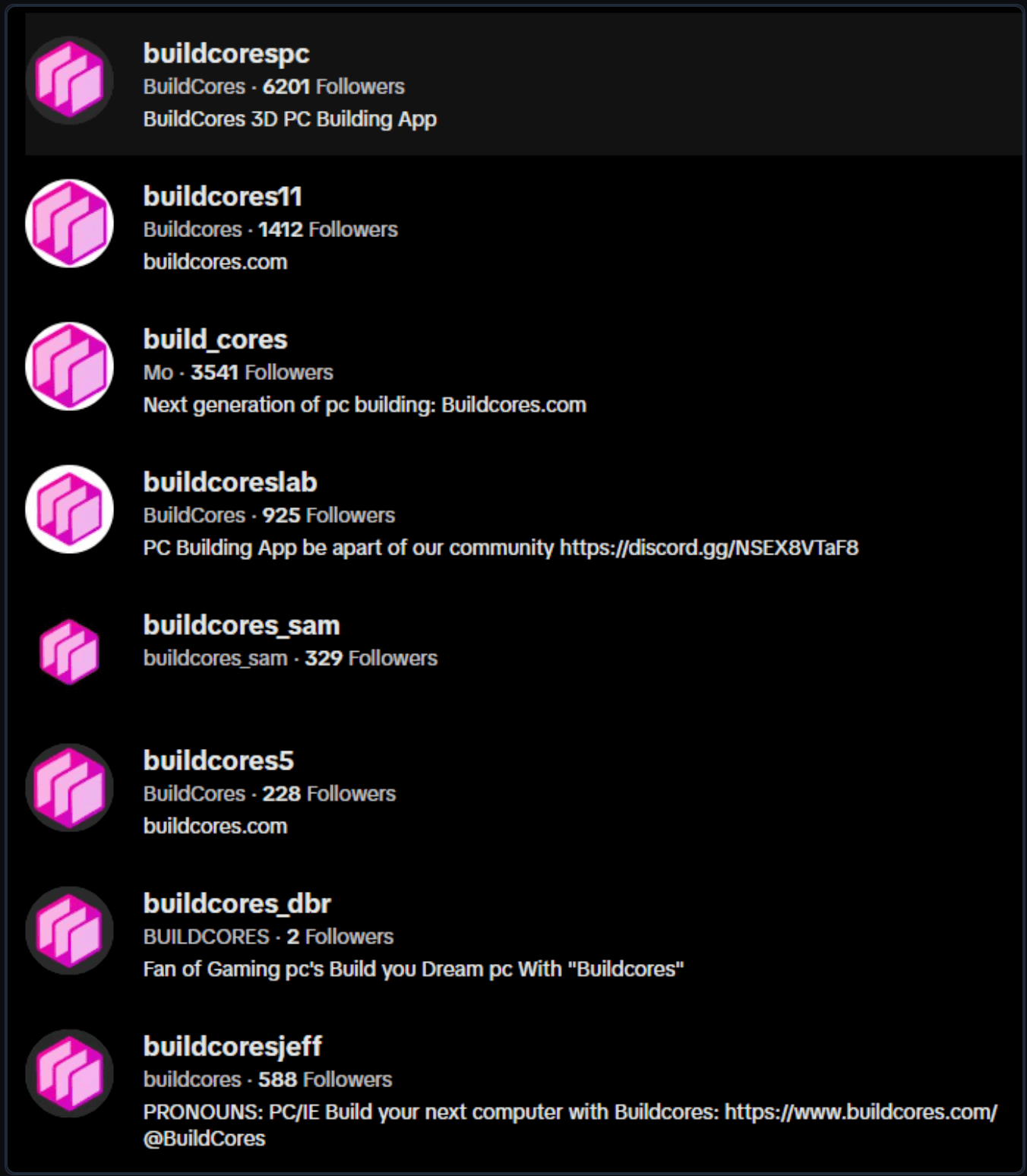
The PC-building app operates a network of 42 social accounts split evenly across two platforms:
21 Instagram accounts.
21 TikTok accounts.
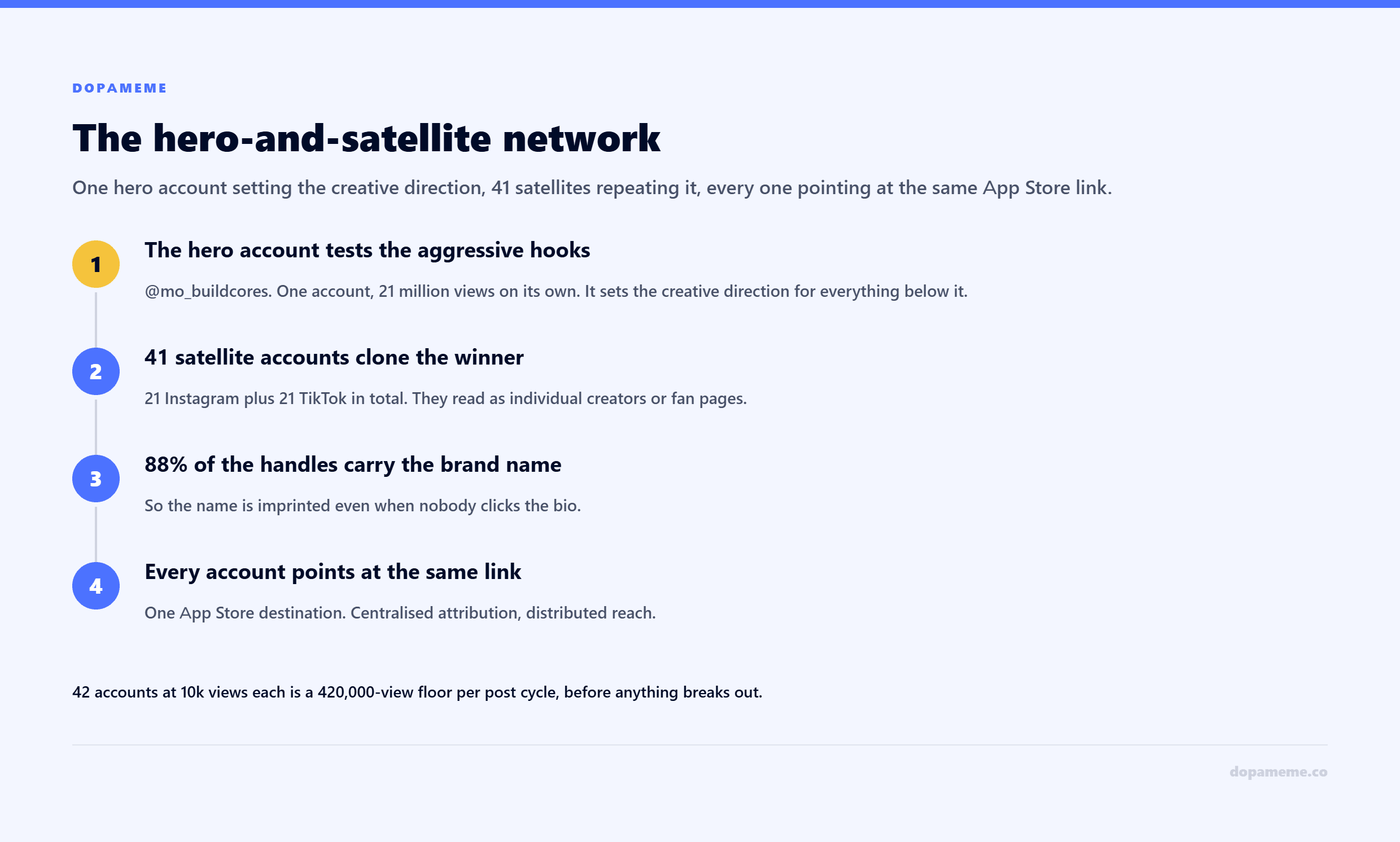
One account acts as the creative leader.
The other 41 increase the number of places where the product can appear.
In the account set reviewed for this case, 88% of the handles contain the word “buildcores.”
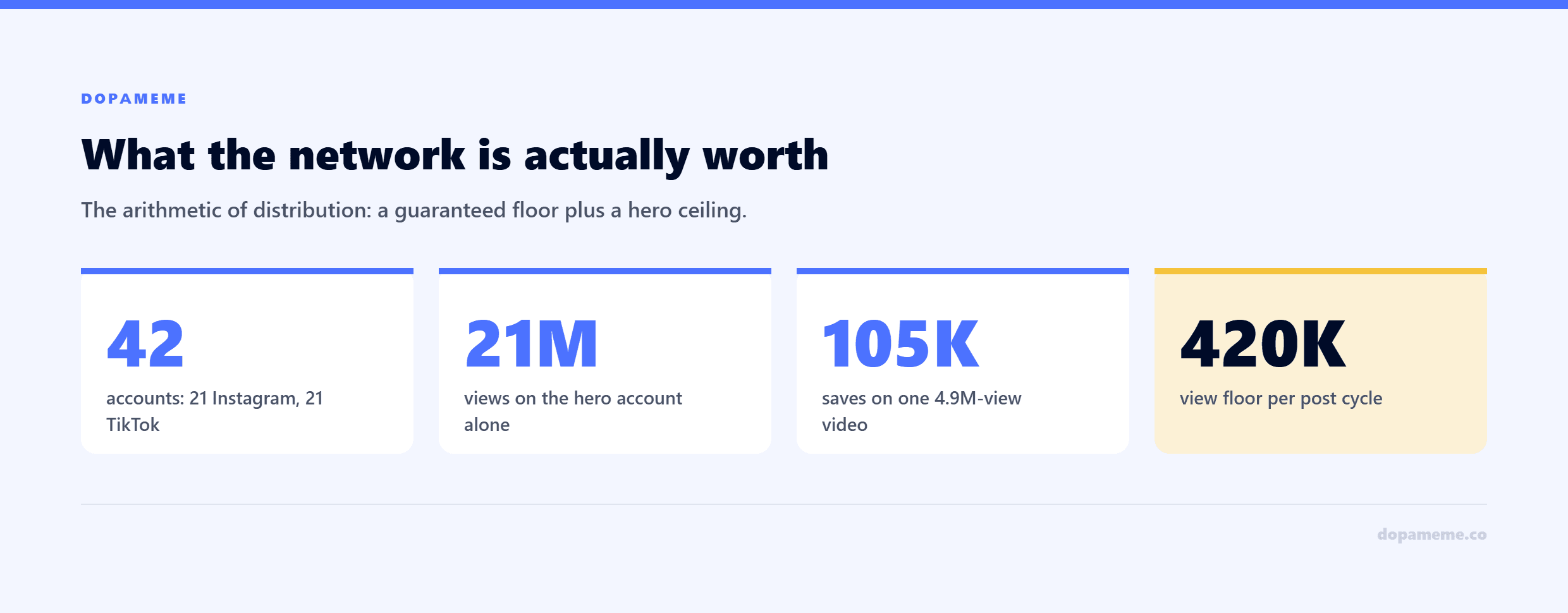
One hero account, @mo_buildcores, generated roughly 21 million views on its own.
One captured 4.9-million-view post recorded 105,000 saves.
And if 42 accounts each generate 10,000 views in a posting cycle, the arithmetic becomes:
42 × 10,000 = 420,000 views.
That last number is not guaranteed reach.
It is what the network produces if every account clears that assumed 10K baseline.
The distinction matters because the interesting part of BuildCores’ strategy is not “make 42 accounts and get 420K views.”
It is the architecture underneath it.
One account finds creative that works.
Dozens of accounts give that creative more places to travel.
And almost every account keeps reminding the viewer which product is behind it.
What is a satellite-account network?
A satellite network is a group of social accounts operated around one product, company or media property.
Instead of asking one account to carry all distribution, the brand spreads content across several profiles.
The accounts may use different hooks, identities, edits or niche angles.
But their traffic ultimately points toward the same destination.
For BuildCores, that destination is the app.
The useful way to think about the structure is:
One product.
One creative system.
Many distribution nodes.
A post failing on one account does not automatically remove the idea from the entire network.
A winner can be adapted and pushed through more accounts.
The brand is less dependent on one username having a good week.
The BuildCores structure: 21 Instagram, 21 TikTok
The network contains 42 accounts.
Exactly half are on Instagram.
Exactly half are on TikTok.
That matters because this is not simply a company creating forty-two Instagram pages and hoping something catches.
The same distribution concept extends across two recommendation systems.
A piece of creative can therefore have more than one chance on Instagram and more than one chance on TikTok.
The network also reduces dependence on the main BuildCores brand account.
Some satellite profiles look closer to niche creator pages than traditional company pages.
That changes how the product enters the feed.
Instead of every piece of content arriving from one corporate identity, BuildCores can approach the same PC-building audience from several accounts and several hooks.
The hero account has a different job
The most important account in the system is @mo_buildcores.
It acts as the hero.
Its job is not merely to repost what everybody else is doing.
It helps establish what everybody else should test.
The account uses aggressive PC and gaming hooks around the BuildCores product.
One hero Reel from the case:
https://www.instagram.com/reel/DPxf5Pjjqlf/
The hero account generated approximately 21 million views across the period captured for this case.
That makes it useful as a creative laboratory.
If one framing starts moving, the company does not need to invent 41 unrelated ideas.
It has evidence for what the audience is already responding to.
That is the separation that makes the model interesting:
The hero searches for winners.
The satellites distribute winners.
Trying to make all 42 accounts equally original would create an enormous production problem.
Centralizing the creative direction makes the network more manageable.
Forty-one satellites create more distribution attempts
Now imagine a winning concept leaving the hero account.
Instead of receiving one publication opportunity, variants of it can appear across the wider network.
Different account.
Different audience sample.
Different platform.
Potentially a slightly different hook or edit.
That does not mean every repost will work.
Far from it.
It means the company has increased the number of attempts.
If one account performs poorly, the entire creative idea has not necessarily failed.
If another account catches, the product still receives distribution.
This is the same reason a company might test several ads instead of making one advertisement and declaring the market uninterested after the first result.
The satellite network applies that logic to organic social distribution.
The 88% handle rule is doing branding work
This is one of the most interesting details in the network.
In the 42-account set reviewed for this case, 88% contained “buildcores” in the handle.
That works out to roughly 37 of 42 accounts.
At first, that seems to work against the idea of using creator-like satellite profiles.
If the goal were to hide that the accounts belonged to one network, putting the brand in almost every username would be a strange choice.
But it solves another problem.
Recognition.
A viewer might encounter:
@mo_buildcores
Then another BuildCores-related account.
Then another.
Even if the viewer never taps the bio on the first encounter, the product name keeps appearing.
That turns the username itself into part of the media.
The repetition is doing brand work before the click happens.
What the network is actually worth
The easiest way to understand a 42-account system is through arithmetic.
Suppose every account generates only 10,000 views from a particular posting cycle.
That gives:
42 × 10,000 = 420,000 aggregate views.
Again, this is not a guarantee.
An account may get 500 views.
Another may get 500,000.
Some versions may not be posted at all.
The 420K figure is useful as a scenario for understanding why a distributed network behaves differently from one account.
With one account, a mediocre 10K result is a mediocre 10K result.
Across 42 accounts, the same average becomes 420K aggregate distribution.
Then there is the ceiling.
The hero account alone generated approximately 21 million views in the period recorded for the case.
A separate captured post with 4.9 million views recorded 105,000 saves.
That save number is particularly interesting because it suggests the content was doing more than creating passive impressions.
People were keeping it.
For an app showing PC builders something they may want to use later, that behaviour makes sense.
Why apps are unusually suited to this model
The BuildCores setup has an advantage many businesses do not.
Every account can eventually point toward the same digital destination.
There is no local inventory problem.
No different store for each city.
No salesperson required to fulfil a click.
Someone in the audience sees a PC-building video.
They become interested in the tool.
They arrive at the same app.
That gives BuildCores centralized conversion with decentralized distribution.
The content can spread.
The product destination stays simple.
This is much harder for a business where every lead needs a long sales process or where each account needs a different operational response.
Why not just put everything on the main account?
Because the main account then has to do every job.
Test ideas.
Protect brand consistency.
Publish winners.
Experiment with strange hooks.
Reach new people.
Serve existing followers.
A satellite network separates some of those jobs.
The hero can be aggressive.
A niche satellite can speak to one subset of the audience.
Another account can rerun a concept without turning the main feed into a wall of repeated creative.
There is still coordination underneath.
But the public distribution does not depend on one feed.
Where this model breaks
Forty-two accounts sounds powerful until you imagine operating forty-two accounts badly.
The network creates several obvious costs.
First, content can become repetitive.
A distribution system can turn into spam if every account posts nearly identical material with no reason for the audience to care.
Second, account quality becomes harder to manage.
Forty-two weak profiles do not automatically become one strong media company.
Third, attribution gets messy.
A viewer can see several accounts before installing the app. Determining which account deserves credit is not always straightforward.
Fourth, there is platform risk.
A strategy built around coordinated repetition needs to stay within the rules and spam controls of each platform. What works today can become less effective if recommendation systems begin treating the behaviour differently.
And there is an ethical question.
If a company operates satellite accounts that are deliberately presented as completely independent fans or customers, the audience may reasonably feel misled when it discovers that the profiles are controlled by the brand.
The BuildCores naming pattern reduces some of that ambiguity because roughly 88% of the audited handles visibly include the brand name.
If another company copies the model, I would keep that transparency.
Do not invent fake customers.
Do not fabricate testimonials.
Do not build a network whose entire advantage depends on viewers believing a brand-owned profile has no connection to the brand.
Distribution is useful.
Deception is a different strategy.
Should your brand run multiple Instagram accounts?
Possibly.
Forty-two?
Probably not.
The number only makes sense if the operating system underneath it can support the volume.
A team needs repeatable creative.
Fast editing.
Account management.
Publishing.
Analytics.
A way to identify winners.
A central product that can absorb the traffic.
Without those pieces, multiplying accounts multiplies chaos.
The useful lesson from BuildCores is therefore not the number 42.
It is the separation between:
creative discovery
and
creative distribution.
A smaller brand can apply that without building a small army of profiles.
What a two-person team should actually copy
This is the part I would take from BuildCores.
Not forty-two accounts.
The architecture.
A small team could run:
One hero account for the strongest original creative and the brand’s main identity.
One satellite account for testing alternative hooks, formats or niche angles.
One second satellite for redistributing proven ideas to a slightly different audience.
All three can point to the same product.
All three can carry enough branding that their relationship is not hidden.
And the team can use the hero account to decide which ideas deserve more distribution.
We run a cut-down version of this for clients at Dopameme: three accounts, not forty-two.
That is enough to increase the number of distribution attempts without creating an operation that requires a dedicated team just to remember forty-two passwords.
The principle scales down surprisingly well.
Find a winner.
Give the winner more places to travel.
Keep the destination simple.
The number that matters is not 42
BuildCores’ system is memorable because the network is large.
But the deeper advantage is structural.
One account does not have to discover an idea, distribute it everywhere and carry the entire company’s organic reach.
The work is split.
One node can find the creative direction.
Others can multiply the attempts.
The product remains centralized.
That is why the 88% handle figure matters almost as much as the 42-account figure.
The company is not only spreading content.
It is spreading the name.
A viewer can ignore the first account.
And the second.
Then encounter the same product from another node.
Satellite accounts turn organic social from a single bet into a portfolio of bets.
That can create enormous distribution.
It can also create enormous noise.
The difference is whether the network has a system behind it.
Sources
BuildCores hero account, @mo_buildcores
https://www.instagram.com/mo_buildcores/
BuildCores hero Reel
https://www.instagram.com/reel/DPxf5Pjjqlf/
BuildCores “lag” Reel
https://www.instagram.com/reel/DB6_8R_S_yC/
BuildCores TikTok hub
https://www.tiktok.com/@buildcores
The 42-account count and 88% handle figure come from an audit of the public BuildCores account network captured for this case. The 105K-save figure comes from captured post-performance evidence.
About the author
Talha Abrar runs Dopameme, an organic social agency focused on the systems behind short-form content, distribution and audience growth.
