
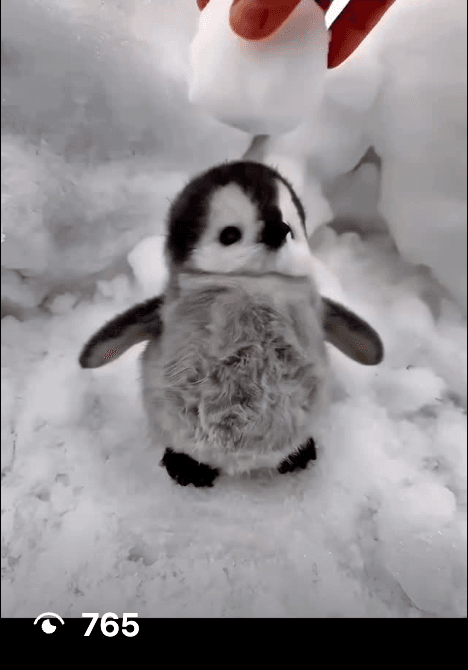
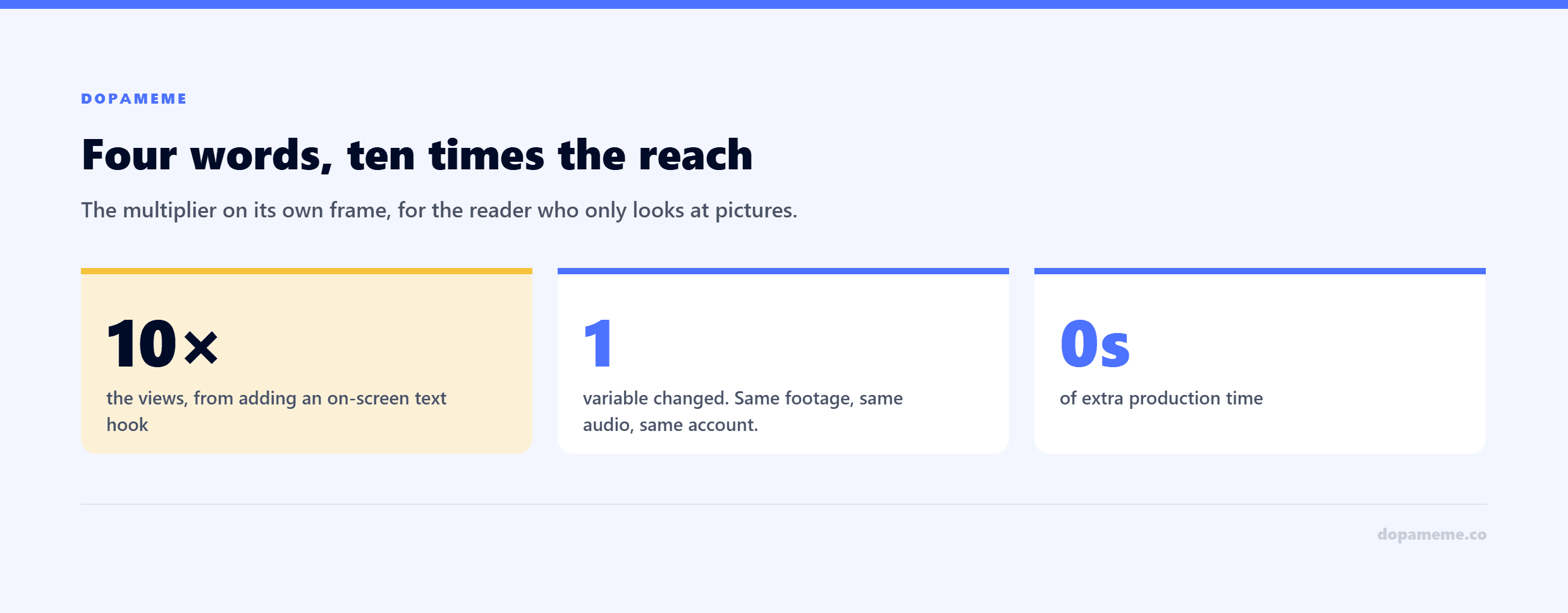
One Reel got 765 views.
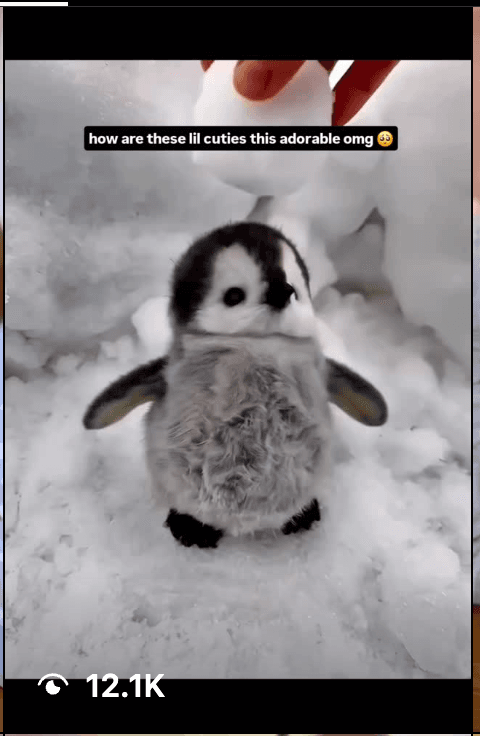
The other got 12.1K.
The footage was the same.
The account was the same.
The test notes record the same audio.
The visible difference was an on-screen text hook.
Based on the displayed view counts, the version with text received roughly 15.8 times as many views.
That is a much larger gap than I expected.
It is also one test.
So the useful conclusion is not:
“Adding text to a Reel gives you 15.8× more reach.”
The evidence cannot support that.
The useful conclusion is:
Something as small as the first line of text can change the way people encounter otherwise identical footage enough to justify testing it deliberately.
What this test actually shows
This was closer to a real-world field test than a laboratory experiment.
One piece of footage was posted in two versions.
One version had no text hook.
The other opened with:
“how are these lil cuties this adorable omg 🥺”
The footage underneath was the same.
The view counts were not.
That makes the text the most obvious visible variable.
But there are still things we cannot control from the outside.
The two uploads may have received different initial audience samples.
They may have been posted at different times.
Early engagement could have changed the recommendation path.
Random distribution variance exists.
That is why I would not claim that the text itself caused every additional view.
But a difference this large is enough to make the variable worth testing again.
Why the first seconds matter
People do not open Instagram intending to study every Reel carefully.
They scroll.
Instagram itself gives creators average watch-time data partly so they can see where viewers disengage and where a stronger opening may be needed. Meta has also made “how to capture more attention” part of Instagram’s creator Best Practices guidance.
A text hook gives the viewer information before the video has had time to explain itself.
Without text, they have to decode the footage first.
With text, the creator can immediately tell them why the footage deserves another second.
That is the job.
Not to summarize the whole video.
Not to fit the caption on screen.
Not to decorate the frame.
Make the viewer stop long enough to understand what is happening.
What a text hook is
A text hook is the first piece of on-screen copy a viewer encounters.
It usually appears immediately.
A useful one should be:
Fast to understand.
Large enough to read.
Specific enough to create a reason to continue.
It has one job:
Stop the thumb.
If the viewer has to squint, decode a paragraph or wait three seconds for the sentence to appear, the text has already missed part of its purpose.
Three text hooks you can use immediately
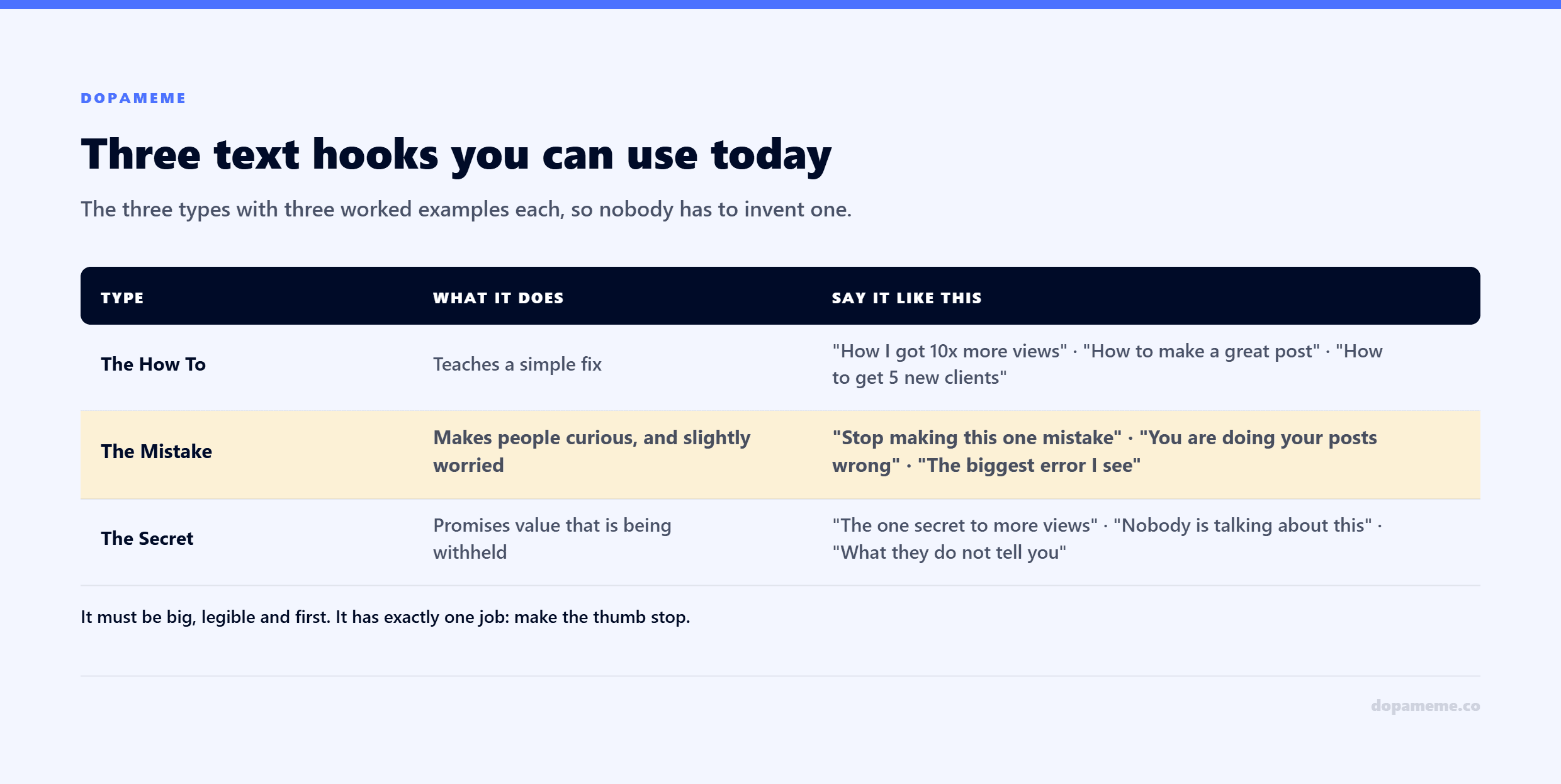
The original test led to three simple categories that are easy to adapt.
The how-to hook
This promises a useful result.
Examples:
“How I got 10× more views.”
“How to make a great post.”
“How to get 5 new clients.”
The strength is clarity.
The viewer knows exactly what the video intends to teach.
The mistake hook
This creates curiosity around a possible error.
Examples:
“Stop making this one mistake.”
“You are doing your posts wrong.”
“The biggest error I see.”
The viewer now has a reason to check whether the warning applies to them.
The secret hook
This promises information the viewer may not already have.
Examples:
“The one secret to more views.”
“Nobody is talking about this.”
“What experts do not tell you.”
This format needs restraint.
If the information underneath it is obvious, the hook quickly starts to feel like clickbait.
The difference between a text hook and a caption
They are not the same thing.
The post caption lives outside the video.
The text hook lives inside the first visual experience.
Someone can encounter a Reel without opening or reading its caption.
The on-screen hook does not wait for that extra action.
That is why the first line deserves disproportionate attention.
A great caption underneath a Reel cannot stop someone who already swiped away.
The two design rules most people get wrong
The writing matters.
So does whether anybody can read it.
Rule 1: it has to be the first thing they see
Do not hide the hook after an intro animation.
Do not spend the opening seconds on a logo.
Do not make the viewer wait for the sentence that explains why the video matters.
If the hook is supposed to stop the scroll, it needs to exist while the decision to scroll is being made.
Rule 2: make it big and legible
Tiny text defeats the purpose.
The viewer should not need to concentrate in order to understand the hook.
One line is often stronger than three.
Shorter is useful when it improves comprehension, not because every hook must contain a specific number of words.
That last distinction matters in this case.
The winning test did not contain four words.
The visible hook was longer.
What mattered was that the sentence was immediate and readable.
Text does not rescue weak content
A hook buys attention.
The video still has to repay it.
If the text says:
“The one secret to more views”
and the next twenty seconds contain nothing useful, the hook has created disappointment rather than retention.
The best text hook does not trick someone into staying.
It helps the right viewer understand quickly why staying may be worthwhile.
That is a much better standard.
How I would test this on your own account
Take an existing Reel where the footage can stand on its own.
Create two versions.
Keep as much else constant as practical.
Same footage.
Same audio.
Same edit.
In one version, add a strong on-screen hook immediately.
In the other, do not.
Then repeat the experiment across several pieces of content.
One result can be noise.
Five or ten tests begin to tell you whether the pattern is real for your audience.
And test different kinds of hooks too.
If your content is educational, it is worth comparing these text hooks with question-based hooks, where the opening asks the viewer to solve or answer something instead of simply reading a statement.
You can see our full breakdown of that format here:
Question hooks beat every other hook by 9×, but only in educational content
The important part is not proving that one hook format always wins.
It is finding out which opening consistently gives your audience the strongest reason to stop and keep watching.
The useful lesson from 765 vs 12.1K
The screenshot is compelling because the change looks almost trivial.
Same little penguin.
Same basic Reel.
One version asks the footage to explain itself.
The other gives the viewer a line of context immediately.
765 views.
versus
12.1K views.
About 15.8× based on the displayed counts.
I would not promise that result to another creator.
I would absolutely test the variable.
The cost is tiny.
The evidence is visible.
And if the first thing someone sees determines whether they give the Reel another second, those few words can be some of the highest-leverage writing in the entire post.
Sources
Primary field test
Before-and-after Reel screenshots reproduced in this article: 765 displayed views without an on-screen hook and 12.1K with one.
Instagram / Meta
New Features on Instagram Reels: Trends, Editing and Gifts. Instagram explains that watch-time insights can help creators identify where viewers disengage and where a stronger hook may be needed.
Instagram / Meta
Introducing Best Practices, an Education Hub for Creators on Instagram. The Creation section includes guidance on capturing more attention and optimizing Reels.
About the author
Talha Abrar runs Dopameme, an organic social agency focused on the systems behind short-form content, distribution and audience growth.
